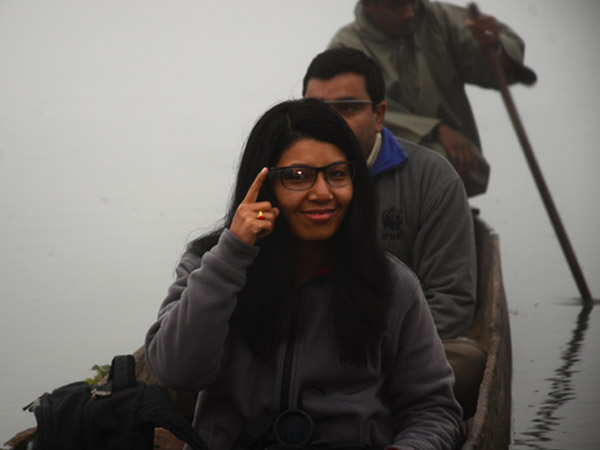
Taking field notes for Sabita Malla, a young biologist and a senior wildlife researcher at Chitwan National Park, has gotten much easier these days. With a Google Glass mounted above her eyes, the 28-year-old sets out fo
 Taking field notes for Sabita Malla, a young biologist and a senior wildlife researcher at Chitwan National Park, has gotten much easier these days. With a Google Glass mounted above her eyes, the 28-year-old sets out for the park’s forest, and with the aid of mostly verbal commands she documents rhino habitat, their behaviours and other data points of interest. All Malla has to do to record a rhino’s location, marking features, possible age, sex and so on is train her eyes towards her subject of interest and issue a voice command; and the glass documents the details and stores it. To snap a picture, all she has to do is wink. Malla was provided the Google Glass by WWF, which has partnered with Google on a pilot project ‘Giving Through Glass Programme’. The five-million dollar project is the first in the world to use Google Glass to help study rhinos. Under the programme, WWF was invited to be a Glass Explorer in 2013 by Google. Similarly, with the help of app developers a custom-built Glassware, ‘Field Notes’, was developed by WWF in partnership with Google to create the optimal software for recording the data in the ID-based rhino monitoring programme. “As a researcher, it’s part of my job to try, test and use the best science and tools available to help Nepal remain a refuge for rhinos, tigers, elephants and other species. And to that end, this glass has been a big help,” says Malla. Her field work, which once required pen, paper and a fine sense of balance when she was perched atop elephants, is now a hands-free experience. If the developers work with the suggestions that Malla has provided them, then the glass might perform even better. At present, the data documented by the glass is stored as a flash memory which has to be transferred to the computer. But soon, Malla says, the glass might be able to relay real-time information to servers. “I have also requested the developers to include a heat sensor to sense the presence of animals,” Malla says. At present there are around 534 rhinos in Nepal, most of them in CNP. The concerted efforts by all the concerned bodies, including the government and local communities, have helped revive rhino population, which was facing severe threats from poaching. This increase in rhino population would have meant longer hours spent documenting them—but with the Google Glass, it happens in the wink of an eye.
Tags:
#google glass
#rhino with tabs
Share this article
A
admin
Crafted for travellers who want grounded planning insight, mountain context, and a clearer feel for the journey before they go.