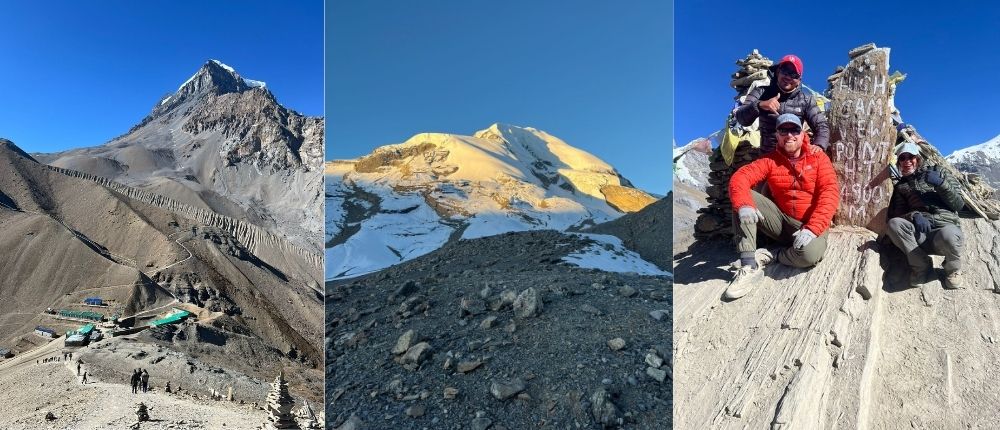
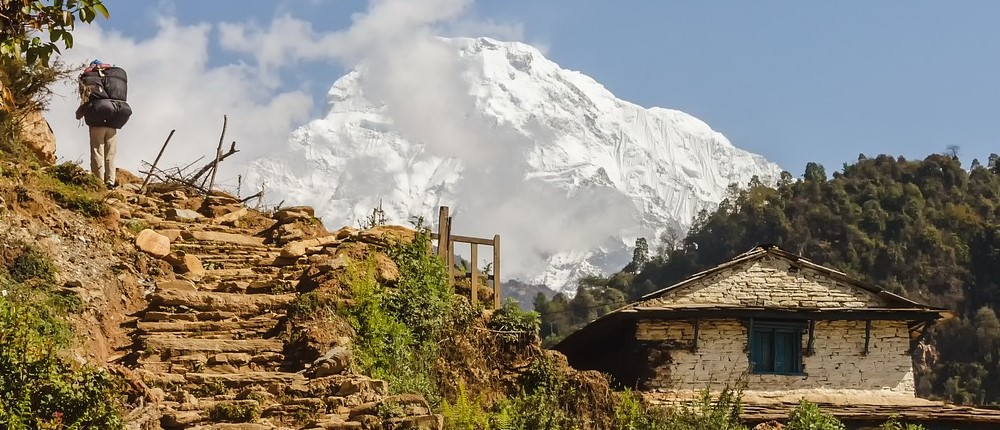
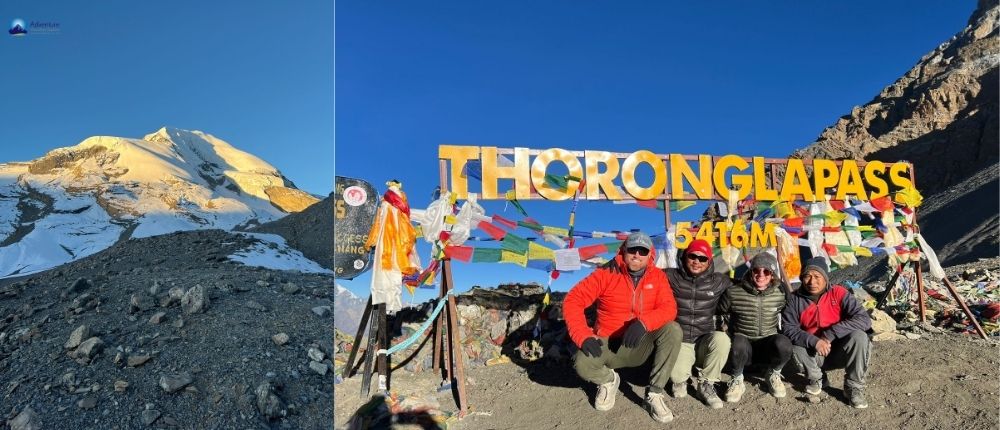
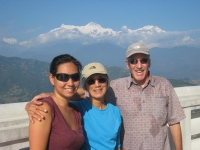
Annapurna Circuit trek or Annapurna round trek in central Nepal is one of the most eclectic and celebrated long treks in the world. The trail, following the counter-clockwise direction, goes through two different river valleys (Marshayangdi and Gandaki), five districts (Lamjung, Manang, Mustang, Myagdi and Kaski), one of the highest navigable passes (Thoroung La Pass -5416m) and the deepest gorge (the Kali Gandaki Gorge) in the world, in just 19 days. This single walk around the Annapurna massif makes it possible for trekkers to experience some of the most beautiful faces of the peaks in the Annapurna and the Dhaulagiri range, including the 7th (Dhaulagiri) and the 10th (Annapurna I) highest peaks in the world. Apart from the view of the peaks, this trek also presents a very good opportunity to document a collection of landforms, such as plains, hills, mountains and plateaus; witness varied climatic zones and the vegetation and wildlife that flourish in it and the observe the eclectic lifestyle, religion, culture,
tradition and housing style of more than 10 different culturally-rich, ethnic groups residing along the trail.
Additionally, the temple of Muktinath (a very important pilgrim site for both Hindus and Buddhist), Lubra Village (one of the ancient Bon Villages) in the Lubra Valley, Poon Hill and Ghyaru (the best lookout point to view the peaks that make the Annapuran and Dhaulagiri rage), and the Ghandruk Village (a place to experience authentic Gurung Culture) are other notable attractions of this Annapurna round trek in Nepal. Moreover, the trekkers will also have abundant opportunity to witness and capture the photo of placid lakes, glorious waterfalls, dense thickets and a number of temples and monasteries preserving fascinating history, historical artifacts, ancient beliefs, religious stories and their deities.
This 19 days Annapurna Circuit trek package is a full or long Annapurna Circuit Trekking package that starts with your arrival in Kathmandu. You will spend one full day visiting the attractions in the Kathmandu Valley. Then the following 2 days' drive will take you to Chame, where you start the Annapurna Circuit Trek, the journey on foot. From Chame, making your way through Pisang, Ghyaru, Ngawal, Manang, Ledar, Thorung Phedi/High Camp, Thorung La, Muktinath, Lubra, Jomsom Tatopani, Shikha, Ghorepani and Tadapani,you will end this trekking journey in Ghandruk. From Ghandruk, you will drive to Pokhara, spend one more day in Pokhara as per your choice and then drive back to Kathmandu to end the trip the following day.
March to May and October to Early December are the best times to do this trek in Nepal. This Annapurna Circuit trek itinerary makes the best choice for those avid trekkers, who are looking for a challenging long trek or those not bound by time. This trek is also perfect for all passionate landscape photographers. Nevertheless, if you want to cut it (the itinerary) short, you can also choose to end the trek in Jomsom. See our 15 days Short Annapurna Circuit Trek for more information. But, if you want to add more hike to the itinerary, you should go for our Annapurna Circuit with Annapurna Base Camp Trek.
Trip Includes
- Airport transfer service upon arrival and departure (private car/jeep/minivan-dependingon the group number)
- 3 nights twin-sharing accommodation with breakfast in Kathmandu (3 Star Standard Hotel)
- One full day guided city tour in Kathmandu Valley (private car/jeep/minivan- depending on the group number)
- 2 nights twin-sharing accommodation with breakfast in Pokhara (3 Star Standard Hotel)
- Deluxe Tourist Bus transfer from Kathmandu to Besisahar (Private car/jeep can be arranged at extra cost)
- Shared jeep transportation from Besisahar to Chame (Private jeep can be arranged at extra cost)
- Shared jeep transportation from Lubra to Jomsom
- Public bus transportation from Jomsom to Tatopani
- Shared jeep transportation from Tatopani to Shikha
- Shared jeep transportation from Ghandruk to Pokhara
- Luxury tourist bus transportation from Pokhara to Kathmandu (private car/jeep/minivan or even flight can be arranged at extra cost)
- All required trekking permits
- Meals (breakfast, lunch and dinner), during the trek
- 3 cups tea/coffee (served in cups only) during the trek
- Seasonal fruits served after dinner everyday during the trek
- Purified drinking water (unlimited) during the trek
- All accommodation (twin-room) in normal standard lodges during the trek
- One government-licensed, English-speaking, knowledgeable and experienced guide and his entire expenses. (Guide-Guest ratio 1:6)
- One porter (for each two trekkers) and his entire expenses
- Insurance of guide and porter
- All required local and government taxes
- Duffle bag and trekking route map (souvenir)
- Down jacket and sleeping bag (if required)
- Adventure certificate on completion of the trek
- Basic First Aid Kit with Oximeter
- Farewell dinner
Trip Excludes
- Nepal arrival visa
- Lunch and dinner (except farewell dinner) in Kathmandu and Pokhara
- Personal expenses like mineral water, alcoholic/non-alcoholic beverages, extra meals, hot water for drinking or any other purpose, laundry service etc.
- WiFi, battery charging and hot shower services
- Transportation to explore attractions in Pokhara (can be arranged at extra cost)
- Flight from Pokhara to any other destination (can be arranged at extra cost)
- Cost of boat ride or any other adventure activities in Pokhara and Kathmandu
- Any extended trips, accommodation and meals
- Monument entrance fees in Kathmandu and Pokhara
- Meals and accommodation in Pokhara and Kathmandu in case of early return
- Travel insurance that covers helicopter evacuation over 5000 meters, trip cancellation and the treatment cost caused by unforeseen illness/disease/situation
- Tips (as an appreciation) to the service providers
Useful Information
Travel Insurance
If you are planning your next trek in the Annapurna region of Nepal, then it is highly recommended that you get a travel insurance that covers all the additional and unforeseen expenses that might occur as a result of different injuries or accidents (together with ambulance, helicopter, rescue and other treatment cost) and various other health related issues. Moreover, the policy should also fund the entire activities that you are planning to take on throughout your stay in Nepal. In addition, the policy should also finance misplaced luggage, theft and liability, cancellations, medical treatment (including hospital charges, cost of the medicine and doctor’s fees), death and repatriation cost as well. This trek requires walking above the altitude of 4,000, therefore, it is kindly requested to ensure that your insurance policy covers trek that goes over 4000m. In short, all unforeseen expenses during the entire trek are trekkers’ sole responsibility.
Health, fitness and experience requirements:
Trekking along the trail of Annapurna region is identified as one of the long distance trekking in the world. Therefore, the trek demands good stamina, excellent health condition and the highest level of mental determination. Some sections of the trek take you to the altitude of over 4000m and some days require 7-8 hours of walking. Therefore, it is well recommended to plan your trek when you are at your best health condition.
The trek is considerably moderate and attainable. Yet, it is highly recommended that you seek advice, medication, and permission from your doctor before scheduling your trek. You can also take the help of the local General Practitioner in order to consult the necessary guide walks before planning the trek. (Running, cycling, or a few hours of uphill walking are considered as some of the best ways to practice for your next trek. This also helps in minimizing the potential effect of Altitude Mountain Sickness.) In the absence of GP, various travel clinics can also assist you with the needed guidance. However, this trek can be easily attained even without any technical knowledge, but prior hiking, trekking and camping experience will definitely make the walk easier.
Note:
We kindly request you to submit your medical fitness certificate (which must include your present health condition, medical situation, preceding illness, and the medications you are taking) before booking the packages. We also request you to be honest so that we can get prepared and take quick action in case of any emergencies.
Meals and Accommodation:
In order to ensure a comfortable stay and relaxed ambiance, we do the booking in one of the best tourist standard hotels before and after your trek. The rooms offered by these hotels are normally twin share, which requires you to share your room with another member of your group. However, this totally depends upon the size of your group and the availability of rooms in the hotel. Triple share is also available on request and a single supplement room is also available at an additional cost.
During the trek, your stay is arranged in local guesthouses or lodges (with shared amenities) en route. A full board meal (Breakfast, Lunch, Dinner and tea & coffee) will be served from the teahouse menu. For breakfast usually western food like porridge, oatmeal, local bread, and toast are offered. The food served for lunch and dinner can be chosen from the teahouse menu.
Our attempt while you are on a trek:
Our guides will make every possible attempt to make your trip successful and for this purpose they strictly follow the itinerary provided to you (except for any formidable situation). Trekking in the Annapurna region of Nepal takes you to those remote areas of Nepal, where communication facilities are very rare. Hence, to maintain regular contact our guides are also provided with cell phones. This can also be used by trekkers to send any message that you want us to deliver to your family, friends or relatives. We can also help you reschedule your international flight (extra charge applicable) if you are looking to extend the days to complete your trek.
Why trek with us?
AME Treks and Expedition offers fully customized packages that are specifically designed to meet each individual trekker’s needs, requirements and budget. Partnering with AME directly allows you to deal with someone who has an in-depth practice of walking and knowledge regarding the track we follow. This in turn will definitely benefit you as you can get information based on their personal experience. We also team up with the local residents of Annapurna region who can take you to those remote areas of Annapurna region that have never been explored before. It is simply a bonus trip for you.
We only hire professional, experienced and knowledgeable guides and team leaders that are dedicated to offering their trekking experience to make your trip successful. Moreover, the most important thing during the entire trek is trekkers’ safety. Therefore, we provide those trek leaders that possess the highest level of qualification in Advanced Wilderness First Aid so that they can take every possible safety measures required to respond rapidly to changing situations during the trek. We also try our best to communicate with you, to help you with your additional requirements during the trek.
To provide a top level of food and accommodation experience, we partner with some of the best lodges and teahouses en route that can produce culinary delights both locally grown and western varieties. We also make sure that the food provided to you is hygienic and balanced and the living space clean and cozy.
Moreover, all the formalities required during the trek will be taken care of by the team leader assigned to your group. Therefore, partnering with gives you the opportunity enjoy a hassle-free trek.
Our legal documents:
AME Treks and Expedition is a certified company and is registered under the government of Nepal. We have special authority of the government of Nepal to operate treks, tours, expedition and other tourism related programs in Nepal, Tibet and Bhutan. Besides, we are also a very active member of other professional organizations like;
Ministry of Finance, Department of Taxation
Company Registration Office, Pvt. Ltd.
Ministry of Tourism and Civil Aviation, Department of Tourism Industry
Central Bank of Nepal, Nepal Rastra Bank Foreign Exchange Department
Nepal Tourism Board (NTB)
Trekking Agents Association of Nepal (TAAN)
Kathmandu Environment Education Project (KEEP)
What are the best seasons to plan this trek?
Though Nepal can be visited any time of the year, the best season to plan your trek in the Annapurna region of Nepal is spring and autumn.
Spring - March, April and May are considered the best month to pay your visit to the Annapurna region because during these months you can experience the warm weather, clear skies, good temperature and the best visibility.
Autumn – Mid September, October and November is also considered the best month to visit the Annapurna region because of the best visibility, clear blue skies and excellent trail.
Winter – December, January and February are good, if you can prepare yourself to experience the extreme cold weather.
Summer – Mid June, July and August are not considered as the right time to visit the Annapurna range as the monsoon rain affects everything that is, trail, weather, temperature as well as the visibility.
What should I bring?
Along with warm clothes you will also need other equipment for the sufficient protection of your body. Below is the list of necessary items that you need to pack before commencing your trek.
Head- Hat (with a wide brim), Sunglasses (with UV protection), Sunscreen lotion and Lip balm
Upper body- T-shirts (2), light and expedition weight thermal tops, Fleece jacket and pullover, Fleece wind-stopper jacket (Optional), waterproof (preferably breathable fabric) shell jacket, down vest/jacket (included)
Hands - Lightweight gloves, heavy-weight gloves/mittens with a waterproof outer shell
Lower body - Underwear (4), hiking shorts (2), lightweight cotton long pants, light and expedition weight thermal bottoms, Fleece or wool pants, waterproof (preferably breathable fabric) shell pants
Feet - Thin, light-wear inner socks (4), thick, warm wool hiking socks (4), hiking boots with spare laces, camp shoes (sneakers and/or sandals), gaiters (only for winter)
Accessories - Sleeping bag rated to zero degrees F (included), headlamp with spare bulb and batteries, small padlock or combination lock, basic first aid kit, large plastic bags (for keeping items dry inside trek bag), day pack, water bottles (2), hiking pole/walking sticks, small ear plugs
Toiletries – Soap, shampoo, toothbrush, small wash towel
Extras - Cameras with extra batteries and cards, binoculars, light balaclava or warm fleece hat, reading books, trip map/guide book, journal & pen, iPod & travel games (like cards, chess, and backgammon)
Passport and Visa Information:
It is very easy to obtain Nepal’s visa. You may either apply for a visa at your nearest Nepalese Embassy/Consulate or Mission offices in your own country or you can buy this upon your arrival at Tribhuvan International Airport in Kathmandu. To apply for a visa, you need 2 passport size photographs, Visa fees in US dollars and your passport that is valid for at least 6 months before the trip. However, nationals of SAARC countries (India, Bhutan, Sri Lanka, Pakistan, Bangladesh, Maldives and Afghanistan) and China do not require any visa to visit Nepal. Transit visa for foreign nationalities is only provided for 3 days. Therefore, visa is required for longer stays. However, for the convenience or foreign nationals, a visa is also provided from the borders listed below:
Tribhuvan International Airport (Kathmandu)
Kakarvitta, Jhapa (Eastern Nepal)
Birgunj, Parsa (Central Nepal)
Kodari, Sindhupalchowk (Northern Border of Nepal)
Belhiya, Bhairahawa (Western Nepal)
Jamuna, Nepalgunj (Mid Western Nepal)
Mohana, Dhangadhi (Far Western Nepal)
Gaddachauki, Mahendranagar (Far Western Nepal)
Tourist Visa Fees:
Transit visa (3 days) – Free of cost
Multiple entry (15 days) – 30 USD or equivalent convertible currency
Multiple entry (30 days) – 50 USD or equivalent convertible currency
Multiple entry (90 days) – 125 USD or equivalent convertible currency
(For more information, please contact the Department of Immigration, Kalikasthan, Dillibazar, Kathmandu.
Tel: 00977-1 4433934/4429660/4438862/4438868. You can also download visa form from – www.immi.gov.np