Glenn Zhang
Great Adventure with Great people!!!!!
"Great Adventure with great peoples.. Unforgettable experiences.. The great team and enjoyed my trip."
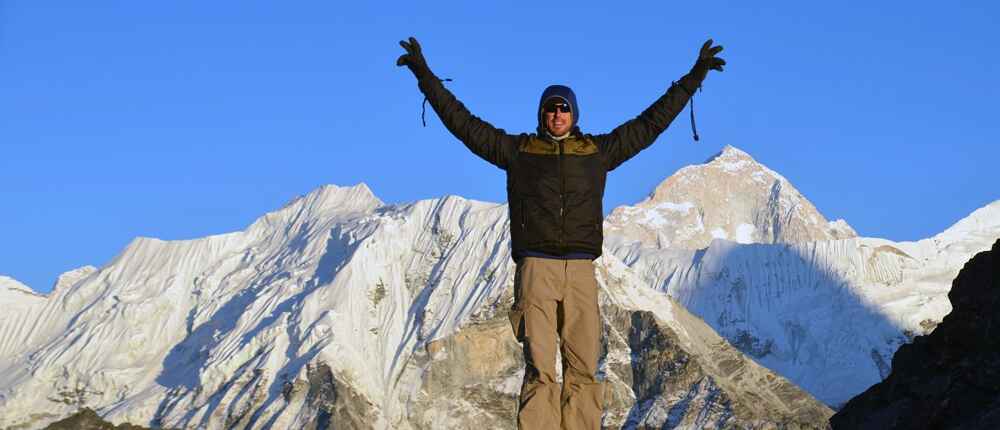
Kathmandu-Lukla-Namche-Gorekshep-Everest Base Camp-Chukung-Island peak-Namche-Lukla-Kathmandu
Quick Facts
A fuller introduction to the route, pace, terrain, and overall trip style.
Everest base camp trek and Island peak climbing gives you both test of trekking and climbing which is a bit challenging and one of the most exciting adventure trip in the world. There are several ways to start this life time adventure trip. The most common is flying to Lukla and Trek to Everest Base Camp and back to Lukla to fly out to Kathmandu. This trek takes you through the most popular village of Khumbu region to the Base Camp of the world’s highest mountain Mt. Everest (8,848m/29,021ft).The highlights of the trek is spectacular views of Himalayan range and Everest Base Camp and of course Island peak climbing which is lifetime experience. Hike to Kalapathar (The literal meaning is Black Rock) is an interesting with its most dramatic views of Mt. Everest, Pumari, Nuptse, and Lhotse along with incredible peaks of entire Khumbu region. This is a great fusion of spectacular views of Himalayan range and richest Sherpa people with its unique culture.
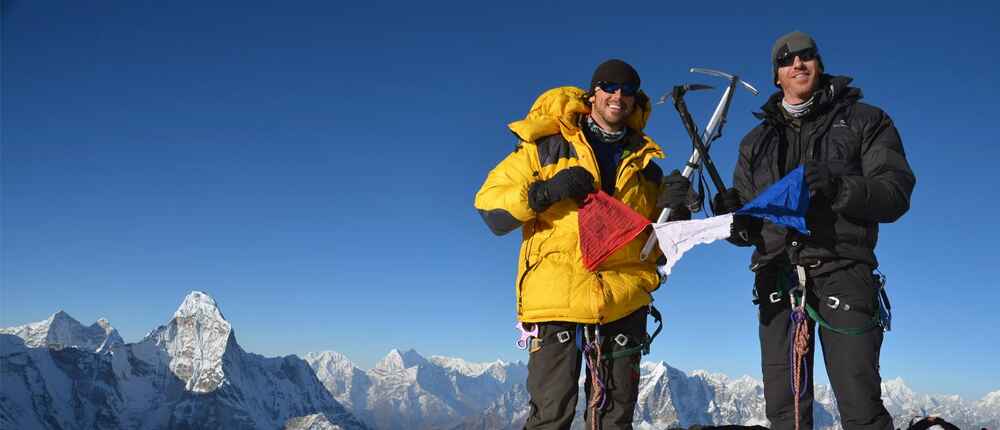
Island peak also called Imja Tse 6189m is the most popular trekking peak to climb in Everest region. It is located on top of the Chukung glacier between Ama Dablam and Lhotse Mountain. This mountain was named "Island Peak" in 1952 AD, by a climbing team of Eric Shipton, due to its striking location in the middle of the Chhukung valley, like an Island on a sea of ice. Island peak was first ascended in 1953 by a British team as preparation for climbing Everest. Island Peak climbing trip fulfills the dream of every amateur and serious climbers, who have been seeking the thrill of adventure and wish to take adventure climbing trips beyond simply trekking in Everest.
Special Notice: Due to unpredictable weather conditions in the Himalayas there may be unforeseen schedule changes with domestic flights to Lukla and from Lukla. The flights may be delayed for several hours or pushed back by a day or more, depending on the circumstances. Although this is rare, it can happen even during the best trekking seasons. As you know, high altitude weather conditions can be difficult to predict. Therefore, we strongly suggest that you plan for this by allowing for an extra day or two in Nepal after your trek, if possible. This will help ensure that you have some flexibility with regard to your trek. On the other hand, if everything goes according to plan, you will have time to enjoy other activities such as rafting, wildlife viewing, shopping, or just relaxing after your adventure.
*Another option (in case of flight delay/cancellation) is to take a helicopter to/from Lukla. If you choose to go this route, we can arrange everything upon request.
Due to the air traffic in Kathmandu International Airport, Civil Aviation Authority of Nepal (CAAN) decided to operate Lukla flights to/from Manthali Airport Ramechhap during major trekking seasons. For this autumn, 2022, It is likely that all the flights to/from Lukla will be operated from Ramechhap airport from 1st October. Ramechhap is about 130 km northeast of Kathmandu and takes about 4 hours and 30 min drive. As the flight to Lukla will be in the morning, we should be there on time./ To make sure we would like to do half day city tour on day 3 and drive to Ramechap in the evening. Spend a night near the airport and the next morning fly to Lukla. We will organize a private transfer to/from Kathmandu to Ramechhap for Lukla flight.
Nepal is a land locked country which lies in between India and China. It is one of the richest countries in the world in terms of bio-diversity due to its unique geographical position and altitude variation. The elevation of the country ranges from 60 meters above sea level to the highest point of the world, Mt. Everest at 8,848 meter above sea level. Nepal is small country but many interesting things to see. Nepal is the second richest country in the world in terms of water resources. We have beautiful Himalayan range in the north and have many rivers begins from the Glacier of the Himalaya. Nepal has three major geographical range Himalayan region, Hill region and Terai low land.Nepal offers abundant potentials to evolve as a round the year travel destination. Based on this fact, many international tourists are indeed incorporating Nepal in their preferred travel itinerary. Nepal is known for its beautiful and dramatic scenery. Passionate walkers and non-walkers alike are attracted towards its mountains and foothills to view the Himalaya and the world highest peak. Many also discover the beauty of the forests and the enjoyment of time spent as a self contained expedition, far from the rush of the modern world and in the delightful company of the trek crew as they tend to our needs and ensure that we comfortable and able to enjoy the trek to the fullest. They are physically strong, sharp-witted and have an incredibly positive attitude towards a life that we would consider extremely tough. There is something trek in the Himalaya that draws you back time and time and again. For keen walkers it is a paradise and non-walkers find that one foot just seems to follow the other, drawn by the appeal of what lies beyond. Nepal's population of over 29 million people is a blend of Hindu, Buddhism and animist religion. Nepal is a mosaic of cultures, ethnic groups and languages. It is remarkable that there are over 100 different ethnic groups, with at least as many languages. More than three million people live in Kathmandu Valley, but at least ninety percent of the Population lives in the rural areas of the lower and middle hills of the Himalayan Range. Nepal is predominantly a simple rural society. Nepal has been declared Federal Republic State on May 28th 2008.This historic development followed the first elections held since 1999 after a ceasefire agreement between the government and the Maoists was signed in November 2006, putting an end to 10 years of instability in the Kingdom. The announcement of the abolishment of the Monarchy also brought an end to 240 years of Royal rule in the country. Today the general feeling amongst Nepalese is a positive one, and many believe that Nepal is now finally moving forward with a new identity as a democratic nation and a fresh outlook. All we people hope a lot for further progress.
Area: 147,181 sq. kilometers
Geography: Situated between China in the north and India in the south
Capital: Kathmandu
Population: 2,642,799
Language: Nepali is the native language. However, travel-trade people understand and speakEnglish as well.
Currency: Nepali Rupee
Political System: Multi-party democracy
Religion: The major number is Hindu. However, there is a harmonious blending of Hinduism and Buddhism.
Travel season: We do have two best seasons to visit Nepal. We always suggest you to come at the right time of the year as far as possible. So the best time is Spring and Autum.
Spring: - (March, April, May) - Best warmest time to trek. Rhododendron flowers in bloom excellent trails and clear skies, best visibility. Good Temperature, warmest weather of the year.
Autumn: - (Mid September, October and November) - excellent trails, clear blue skies, best visibility.
Winter months: - (December, January and February) are also good, but it’s obviously colder. You have to be prepared for this.
Summer: - Monsoon, so rain and visibility can be a big issue (from Mid June, July and August).We do not suggest you this time to visit Nepal. Nepal can be visited the whole year round.
People: Nepal has more than 91 ethnic groups and 70 different spoken languages.
Important Trip Notes & Activities
Pleased acknowledge that you are joining us for the adventure climbing trip in the remote Himalayan region, where weather conditions, health and fitness of the member or unexpected natural disaster can compel us to change the itinerary and if so you have to understand it but we would try our best to keep the suggested itinerary as per the original schedule. Your safety and satisfaction of the trip is our prime concern while travelling with us and we ensure you our best team, logistics, professional services to make sure that you would have an amazing trip of a lifetime with us. Also note that our trip leader deserved the final decision if the trip has to amend, change the route or cancel due to the extreme conditions for the safety precaution. However, he will try his best to ensure that the trip runs as according to the stated plan but be prepared for flexibility if necessary.
Special train for beginners before fly to Lukla
Island peak is not very difficult climbing but it is technical enough to climb and it is one of the most common trekking peak for adventure climbing experience so you could easily join us for this lifetime adventure. Basic technique and information of mountaineering (such as using crampons on boots, using climbing ropes, ice axe, harness, carabineers, Descender device etc ) is required to plan this trip. So you should have basic knowledge about this. Do not worry if you do not have basic knowledge we are here to train before you head for this adventure. We do train for beginners in Kathmandu before fly to Lukla to start this trip. You need to have an extra day for this as we do take you to the rocky cliff to train you the basic ideas about the climb as you will learn basic ideas to use climbing tools to ensure your successful climbing trip.
Train Yourself
This trip requires walking on maximum altitude above 3500m – 6189m from sea level for the duration of 7 to 8 days. So it is very essential that you should be preparing for this trek before reaching to join us at our trek date at Kathmandu. The best preparation you can do is to hike, even if it is under gym conditions. Running will help your stamina but does not fully prepare your muscles for a strenuous hike. Go for walks. It is advisable to go for frequent walks which should include some uphill and downhill sections if possible in your surroundings. Take your daypack with you with at least a weight of three kilograms or more. This will simulate the conditions you will encounter while on your trekking with us. Join a gymnasium. Ask your gym instructor to work out a fitness program that consists of progressive resistance exercises. An experienced instructor will be able to tailor a safe exercise regime based on your age, condition and strength. Work with a schedule that progresses to higher resistance or weights as you develop your fitness.
Visit Your Medical Doctor:
Please do visit your medical doctor, consult him before heading to such altitude trekking destination. Those who have a problem of heart, lung, respiratory or blood should talk with their medical doctor and take his reference and report us before planning this trip with us.We deserve not to take those on our trip who are having such medical conditions.
Why to Trek with us!
We are passionate to deliver real adventure experience that allows you to visit places that unseen and cultures and traditions that untouched. Trip itineraries are optimized to the best of our knowledge to cover the most famous travel routes and interests of the discerning traveler. We have put our heart, soul and over 15 years of experience into an outstanding adventure trips. We are committed to a high level of service so that all of our customers' expectations are met. Our local Sherpas and Leaders are very much dedicated to their services. It is our highest priority to provide you with the best services available through our company. We are here to fulfill your desire. We can tailor trips to your liking. We know how to cater to the needs of our valuable clients. Our specially trained staff understands the best destinations for people with varying interests, physical abilities, budgets, and ages. Customer care is our priority. We also pass your day to day trip update to your family if required. Our guide and Sherps will have cell phone which works most places on this route. Hence, you can tell us what to write to your family about your trip so that they should not worry about your adventure trip.
Our legal documents
We are a government authorized and certified company. We have special authorization from the government of Nepal to operate trekking tours, expeditions, Tibetan tours, Bhutan tours and many other tourism related services. Besides being registered with the government, we are proud to be members of different professional organizations such as the following:
Ministry of Finance, Department of Taxation PAN No. 304585539
Company Registration Office, Pvt. Ltd. No. 79438/067/068
Ministry of Tourism and Civil Aviation, Department of Tourism Industry License No. 1288/067
Central Bank of Nepal, Nepal Rasta Bank Foreign Exchange Department License No. 1159/1/068
Nepal Tourism Board
Trekking Agent Association of Nepal (TAAN)
Kathmandu Environment Education Project (KEEP)
Travel Insurance
You should have travel insurance to be adequately protected in terms of insurance. A travel insurance policy that should cover cancellation, injury, death, lost baggage, theft,liability, medical treatment and expenses is strongly recommended. Make sure the insurance covers all theactivities that you will be undertaking during your stay in Nepal. If a clientbecomes ill, all hospital expenses, doctors' fees and repatriation costs are the client's responsibility.If you are injured and unable to travel, you can ask for a rescue helicopter from a remote area only if you havedefinite proof you can pay for it. They pay a cash deposit to the helicopter operator and collect the money from youifyou have been rescued. Be sure your policy specifically covers those.
Health and Fitness for trekker
We strongly recommend you to consult the doctor before planning your holidays. You should obtain professional advice from a travel clinic or your local GP about which vaccinations to have before you arrive inNepal. Your doctor will advise current inoculation requirements. If a doctor has recommended against travel orindicated travel may be inconvenient then kindly inform us of the details. On all trekking and exploratory tripstechnical experience is not required, hiking/camping experience is an advantage, but by far the most importantthing is a positive attitude and a generous amount of determination. We run regular first aid courses for our all trekking guides and Sherpa helpers.
Meals and Accommodation
In Kathmandu we use tourist standard hotel to ensure a comfortable stay and relaxed environment before and after youradventure. All breakfasts are included at the hotel in Kathmandu. Rooms are generally twin share – dependingon group size and room availability, triple share may be offered up on your request. A single supplement room isavailable at an additional cost for accommodation and required expenses during the trek to provide good quality food and services. For breakfast you expect to haveporridge, toast or chapattis, omelet and local bread. We will provide all meals on full board(Breakfast, Lunch, Dinner and tea & coffee) from the teahouse menu during the trekking period. Whilst trekkingon the Everest, the accommodation is in guesthouses or Lodges which are basic with shared facilities.Some lodgesoffers shower and mostly offers bucket hot water up on request. During the trip you can expect for 2 times hot shower.
While you are on a trek
While you are on a trek, there are not much communication facilities so that we would pass your message to your family and friends if required. Our guide will have cell phone and we often speak with you so that easy for us to deliver message. Our every effort will be made to keep to the proposed itinerary, however as this is adventure travel in a remote Himalayan region. The health of member, weather conditions can all contribute to changes the itinerary. The leader will try to ensure that the trip runs according to plan, but please be prepared to be flexible if necessary. If you are delayed longer than the itinerary date we can help reschedule your international flights but prepare to pay some extra charge if required.
Climbing Gears
Personal Climbing Gears:
-Ice axe
-Crampons
-Harness
-Tape Slings (2)
-Screwgate Karabiners (2 lock, 2 unlock)
-Descender/Abseil Device
-Plastic Mountaineering Boots
-Ascender
-Helmet (optional)
Group Climbing Gears:
-Snow bar
-Ice Hamer
-Rope
-Ice Screw
Clothing
Head:
- Sun hat or scarf
- Light balaclava or warm fleece hat
- Sunglasses with UV protection
Lower Body:
- Under Garments
- Hiking shorts
- Lightweight cotton long pants
- Light and expedition weight thermal bottoms
- Fleece or wool pants (seasonal)
- Waterproof (preferably breathable fabric) shell pants
Feet:
- Thin, lightweight inner socks
- Thick, warm wool hiking socks
- Hiking boots with spare laces
- Camp shoes (sneakers and/or sandals) Gaiters for hiking in winter to the base camp
-Gaiters
Upper Body:
- T-shirts
- Light and expedition weight thermal tops
- Fleece jacket or pullover
- Fleece Wind-Stopper jacket (optional)
- Waterproof (preferably breathable fabric) shell jacket
- Down vest and/or jacket
Passport & Visa Information
Nepal visa is the easiest visa to obtain; you may buy your Nepal visa at your nearest Nepalese Embassy/ Consulate or Mission offices abroad or buy this upon on arrival to Kathmandu international airport as per your convenient. You have to have 2 passport size photographs, Visa fees in US cash & valid passport at least for 6 months valid at the starting of the trip. Nationals of SAARC countries and China do not need visa when visiting Nepal. As per this rule, Indian nationals do not require visa. Transit visa is provided for foreign nationality for 3 days. Visa must be obtained for staying over the initial period of three days. Currently, foreign national can obtain Nepalese visa from the following border.
Tribhuvan International Airport, Kathmandu
Kakarvitta, Jhapa (Eastern Nepal)
Birganj, Parsa (Central Nepal)
Kodari, Sindhupalchowk (Northern Border)
Belhiya, Bhairahawa (Rupandehi, Western Nepal)
Jamuna, Nepalgunj (Banke, Mid Western Nepal)
Mohana, Dhangadhi (Kailali, Far Western Nepal)
Gaddachauki, Mahendranagar (Kanchanpur, Far Western Nepal)
Tourist Visa Fees
3 days transit visa - Free of cost
Multiple entry 15 days - US$ 30 or equivalent convertible currency
Multiple entry 30 days - US$ 50 or equivalent convertible currency
Multiple entry 90 days - US$ 125 or equivalent convertible currency
(For further information, please, contact Department of Immigration, Kalikasthan, Dillibazar Kathmandu
Tel: 00977-1 4433934 / 4429660 / 4438862 / 4438868, Download visa form-: www.immi.gov.np
Trip Snapshot
Why Book With AME
Well-paced itinerary with acclimatization-friendly flow
Licensed local guides, porter support, and 24/7 operations team
Private customization available for pace, dates, and comfort level
Gallery
A quick look at the landscapes, lodges, and trail atmosphere before you move into the itinerary.
Next up
Scroll into the detailed itinerary to review daily movement, overnight stops, elevation, and practical route flow.
Click any day to expand full details, elevation notes, meals, and overnight stops.
AME Treks and Expedition welcomes you to Nepal. One of the company representatives will be awaiting your arrival outside the baggage hall of the Tribhuvan International Airport (TIA), in Kathmandu. Look for the person carrying an A4 size paper with your and company’s name written on it. Carry your luggage and follow this person to the vehicle (private car) waiting for you to transfer you from the airport to your hotel in Kathmandu. Check into the hotel, and rest for the day unless you wish to walk around with a guide. Stay in a 3 Star Boutique Hotel in Kathmandu.
Enjoy breakfast at the hotel and get ready to meet your guide for checking your gear, we will have a meeting with other trekking members to discuss the trek. After this, you are free for the day to relax and get ready for the trek to Island peak. Options are you can do Kathmandu valley cultural tour, Rock climbing or a day hike near Kathmandu through the jungle as a trek preparation but you will have to pay extra for this. We would recommend the best thing to do by the time as per the weather condition. Stay in a 3 Star Boutique Hotel in Kathmandu.
We drive to airport early in the morning as per flight departure time to take our flight to lukla (2,800m). It is scenic flight about 35 minutes which gives you a perfect site of mountain range. Once you are at Lukla airport, meet our other trekking member there and breakfast at the lodge. By the time prepare luggage for the Porters then walking starts through the stone paved trails towards Bhaisekharka. It is few up downs to get in to Phakding passing through plenty of prayer Rocks (Mani in local language). After getting in to the lodge at Phakding, fresh up and short walk to the village or hike up to the Gompa to get acclimatize. Stay overnight at the lodge.
After hot breakfast at your lodge, the trail leads towards the suspension bridge and easy uphill to the Monju from where Sagarmath National Park begins. After short National Park formalities, drop down to the river, cross another suspension bridge and continue walk to the high Hilary Bridge at the bottom of the hill. After the bridge the trail leads uphill to the Namche Bazzar. On the way you will have great view of Mt. Everest, Mt. Lhotse, Mt. Kusum Khangru and more with beautiful valley. Stay overnight at the Lodge.
Today you explore the Museum, visit Khumjung village and Khongde village where you can enjoy the views of Mt. Everest and surroundings peaks with Sherpa culture. You can also visit Thame which is old Sherpa village as an option. Remaining of the day you can explore Namche Bazzar where you can use Internet, visit National Park head office, Museum and monastery as per your interest and time. Stay overnight at Namche.
After breakfast at the lodge at Namche, the trail leads short up towards ridge and easy way to Kyamjuma then descends slightly to Dudhkoshi at 3250m. After that a steep ascent will bring you to the famous Tengboche monastery, with its picturesque background of Ama Dablam, Mt. Everest and other peaks. Stay overnight at lodge.
At the beginning hike half an hour down to riverside though lush forest to cross the river and gradual climb up to Pangboche which is popular Sherpa settlement. Then the trail continue leads uphill towards north of the valley which has lovely views of Mt. Amadablam, Mt. Everest, Mt. Lhotse and more peaks around. Once you get to the ridge the trail drops down to the valley at Pheriche for overnight.
Today we again acclimatize at Pheriche as a 2nd acclimatize day on this trip. Today you hike up to the ridge for the view and also to get acclimatize. Afternoon walk around the village and overnight at the lodge.
After breakfast at the lodge the trail leads through the valley and get in to the bottom of the hill from where uphill begins to get in to Dugla. After that the trail continue climb upto the ridge where many memories of Sherpa who died on the glacier of Mount Everest. The trail gently climb up to the Lobuche for overnight.
The trail leads toward Gorekshep through the rocky trail. On the way you will have great views of the Mt. Everest,Mt. Nuptse,Mt. Pumori and more. You will be able to see Khumbu Glacier on the way. After few up downs, you will reach at Gorekshep which is located at the bottom of Kalapatthar. This is a day which will fulfill your dreams to visit the base camp of the highest peak in the earth. It is 3 hour walk through the ridge of the Khumbu glacier. You will enjoy the surrounding views of the glacier and mountains. There are Buddhist prayer flags which are the symbol of the Base Camp. During the climbing season there will be many tends with colorful looking around. After exploring around, trek down to the lodge and remaining of the day chill out at the lodge. Stay overnight.
Today you will have to start your day without breakfast in the morning which is 2 hour hike up to the Kalapatthar, the greatest view point of the Mt. Everest, Mt. Nuptse, Mt. Pumori , Mt. Amadablam, Mt. Thamerserku, Mera Peak and many more. After taking many photographs, trek down to the lodge at Gorekshep for breakfast and continue your walk down to Lobuche. Stay overnight at the lodge.
Today you walk towards east of Chukung valley. It is rocky trail today an had beautiful views of mountains and peaks. Once you get in to Chukung at the lodge meet with our Climbing guide and at the same time check climbing gears and equipments. Our guide will brief you about the further expedition towards our targeted point. You can also ask questions to our guide which relates climbing and our guide also tell you his climbing story to different peaks and mounts. Stay overnight at Chhukung.
After breakfast at the lodge, follow our climbing team towards south part then turn east to the main of the valley. Continue walk to the huge rock and cross Imja and Lhotse glacier moraines to get in to the wide valley where we can set the tent. Overnight at tented camp.
After hot breakfast at the camp, climb up the hill where you will see that the slope narrows and the path enter a steep rock channel nearby where you will stop for overnight at camp. At the mean time ur guide will fix crampons on your climbing boots and re-check the entire climbing gears and personal equipment once again for better safety. If required, you may learn last minute climbing technique with our climbing Sherpa at this stage. If possible, you will be also taken for the ice/rock climbing nearby but subject to the availability and depends up on weather. Stay overnight at High Camp.
At very early morning (also depends on the weather condition we may have to wait for another day so be prepare for this) your expedition starts. This is not difficult but there are several short rock steps to climb before you emerge on the right side of the gully. The route then follows a ridgeline, which leads to an exhilarating and exposed traverse onto the snout of the summit glacier. You will need to rope up for the glacier as it contains several crevasses but it leads without difficulty, to a 100m(330ft) snow and ice slope (40-45 Degree) on which the guides will fix a rope. From the top of this slope, 3 rope lengths along a sharp summit ridge leads to the top. After enjoying the summit views you will descend all the way to high camp and you’re your gears to get down to Chhukung for overnight.
After breakfast the lodge, follow the valley towards Pangboche and short climb to Tengboche through the forest of Rhododendron and pine. After that the trail drops steep down to the valley to cross the suspension bridge and continue up to Khumjung for overnight.
After short climb to the ridge the trail drops down through the ridge where you can see the village with its U angle settlement. Evening explore around the town and overnight at the lodge.
After breakfast at the lodge, the trail drops downhill through the pine forest till to the bridge and continue walk to the Monju. Again some formalities has to be done at the check post of the National park at Monju then continue walk to the Phakding for the lunch. After that your last day of the trek continue to the Lukla. Stay overnight at the lodge.
Normally flights are always in the morning due to the weather. So guide will do all airport formalities by the time you can have a breakfast at the lodge. Your luggage will get in to the airport already with the help of our sherpas and porters. Once guide get news about your flight arrival at Lukla airport, will call you to watch how the small aircraft get lands in to the small airstrip. After quick photograph, get in to the airport and straight away get in to the plane to fly out to Kathmandu. Once you are at the airport at Kathmandu, guide will assist to get in to your hotel by private vehicle.
Today is the last day of the trip with us. If you would like to extend your holiday with us, we will help you if you require otherwise we will assist you to the airport as per your flight departure time. If your flight is late evening, you can do last minute shopping or manage your photos of the trip then final departure from the airport.
Itinerary PDF
Take the full plan offline with day-by-day details, trip facts, inclusions, and planning notes.
Compare scheduled departures or request a private version tailored to your group.
No group dates are listed right now, but private departures can usually be arranged for the dates that suit you.
Need a different date or a private departure?
Private departures can usually start on the dates that work for you, with the pace, route style, and group setup adjusted around your plans.
Selected option
You can adjust the traveller count again in the booking form if needed.
A clearer breakdown of what is covered and what you should plan separately.
Included services will be confirmed once this product setup is completed in the admin panel.
Personal extras and excluded services can be reviewed with our team before you confirm your booking.
Travel insurance, personal mountain gear, and international flights are usually arranged separately. If you want help reviewing gear or insurance before you book, our team is happy to guide you.
Practical planning questions generated from this route, itinerary, and trip setup.
The Island peak climbing with Everest Base Camp Trek is generally planned as a Moderate trek in Nepal, with route pacing, altitude gain, and overnight stops shaped around the published itinerary. If you want a lighter or more private pace, our team can usually customize the plan.
You should plan around 20 days for the full trek, including the published route flow, acclimatization needs, and arrival-to-departure logistics. If you need extra buffer days for weather or private extensions, we can map that out before booking.
This journey reaches around 6189 and is usually best enjoyed in October to December and March to May. Trail conditions in Nepal can change quickly with weather, so we recommend preparing for cool mornings, layered clothing, and flexible mountain timing.
The advertised rate starts from $2,795.00 and typically covers the main trip services such as guide support, accommodation, and the core logistics listed in the itinerary. Items commonly handled separately include international flights, insurance, and personal spending, unless your custom quote says otherwise.
The Island peak climbing with Everest Base Camp Trek is a strong fit for travelers looking for small, flexible groups, local lodges and trek accommodation, and a guided Himalayan experience in Nepal. If you are unsure about fitness, private departures, or the right route style, send us your preferred dates and we will guide you to the best option.
Extra planning notes, route expectations, and pre-trip guidance for this journey.
4.9 · 156 verified reviews
Travelled and reviewed
Recent travellers often mention the pacing, guide support, and how clearly the trip was organised.
"Great Adventure with great peoples.. Unforgettable experiences.. The great team and enjoyed my trip."
Recent feedback from journeys with a similar route style or destination feel.
Satoshi
Annapurna Base Camp Trek
"Several months ago, a friend of mine came back from world-round-trip and said, “A.B.C trekking is what you cannot see in any other places but Nepal”, and excitingly showed me a lot..."
Shanna Simmons
Annapurna Circuit Trek
"My mother and I arrived in Kathmandu with just 2 days to prepare for a trek around Annapurna Circuit. We feel very lucky to have met Mr. Tika Regmi and through Adventure Mountain E..."
Rico Grass & Tiziana Margelist
Annapurna Base Camp Trek
"Urspruenglich hatten meine Freundin und ich geplant, das Annapurna Base Camp in Angriff zu nehmen, doch Tika Regmi, Direktor von Adventure Mountain Explore hat uns den Langtang Tre..."
Join 5000 travellers who have trusted Adventure Mountain Explore for thoughtful planning, dependable support, and memorable Himalayan journeys.