Teej will soon be upon us, and one can see intensifying signs of its approach here and there in the city. Clothing and textile stores, for instance, ever eager to cash in on the festive spirit, are already bedecked in se
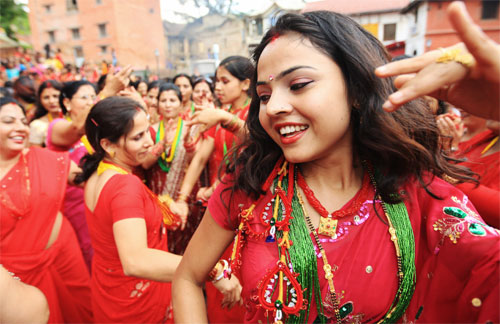
Teej will soon be upon us, and one can see intensifying signs of its approach here and there in the city. Clothing and textile stores, for instance, ever eager to cash in on the festive spirit, are already bedecked in sequinned sarees and kurtas in telltale red, TV channels have begun Teej-related programming, and many families have initiated pre-emptive gatherings, ringing in the festival with song and dance. For Hindu women, Teej represents a time of hope, of idealism—it’s when those who are still single can indulge in fantasies of the perfect, loving husband, and those already married pray for long lives and good health for their significant others. That sentiment is what has largely sustained the collective excitement behind the festival in Nepal for so long. Of course, modernisation of lifestyles in the country and the increasing impact of western culture on the younger generation have taken a toll on Teej proceedings in recent times, and one can see major differences even if one were to look at just the last five years or so. “Many young girls these days don’t really care all that much about things like Teej,” says 19-year-old graduate Samichya Rijal. “I’d bet they’re more excited about Christmas parties.” This is reiterated by Shova Subedi, a civil servant, who says that if girls today do celebrate Teej, it’s more to do with the shopping and pretty clothes than actually subscribing to the traditional beliefs that the festival represents. “You’ll see shops and shopping centres chock full of women looking for outfits,” she says. “But that’s it. It’s a public holiday and little more.” That commercial aspect has also extended beyond shopping to Dar celebrations, with people renting out big party palaces and spending big money, exaggerating what once used to be simple. 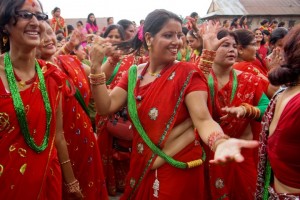 Teej falls on the third day of the waxing moon in the Nepali month of Bhadra, as per the lunar calendar, and its roots in Hindu mythology trace back to the sacrifices the goddess Parvati made as part of her devotion to Lord Shiva. Shiva then represents the ideal man, and on this occasion, women symbolically step into Parvati’s shoes, believing that if they too carry out designated rituals such as fasting and praying, it will translate to good fortune for their loved ones. Fasting and other associated rituals, however, appear to have fallen out of favour when it comes to many young Nepalis. This includes the kind of song and dance routines that were a big part of the celebrations in the past. “Before, women would get together and dance to old folk songs,” says Astha Neupane, a young professional. “Now they have all these modern tunes that they prefer and these don’t really gel with the mood of the festival.” Subedi attributes this to the kind of cultural education children receive while growing up, and says that while her mother’s generation was more or less taught to respect tradition and sustain rituals as a child, families nowadays give very little priority to that sort of thing, and it’s “no wonder” that girls have become very much detached from their roots. “Nothing is wrong with moving with the times, but that shouldn’t mean you forget where you came from,” she says. Bipula Khanal, a marketing officer, on the other hand, doesn’t think all is lost yet. “It’s unfortunate that modernity threatens to wipe out age-old traditions, but there is still time to if not reverse, at least stem that flow,” she says. “If we’re able to give girls an idea of the significance of Teej, and school them in all its traditional values as well as its fun aspects, I think we could get them on board.”
 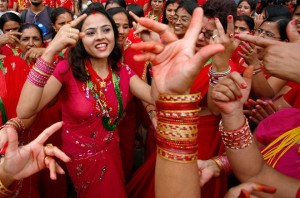 It is clear from my conversations with these women that Teej hasn’t altogether lost its touch when it comes to its place in Nepali culture. Of course, many young women appear to have distanced themselves from the true significance and meaning of the festival, but that is perhaps a given in this modern age. It is at least reassuring to know that there are still many out there who do strive to preserve tradition and who will ensure that Teej will continue to be celebrated in the years to come. source:ekantipur
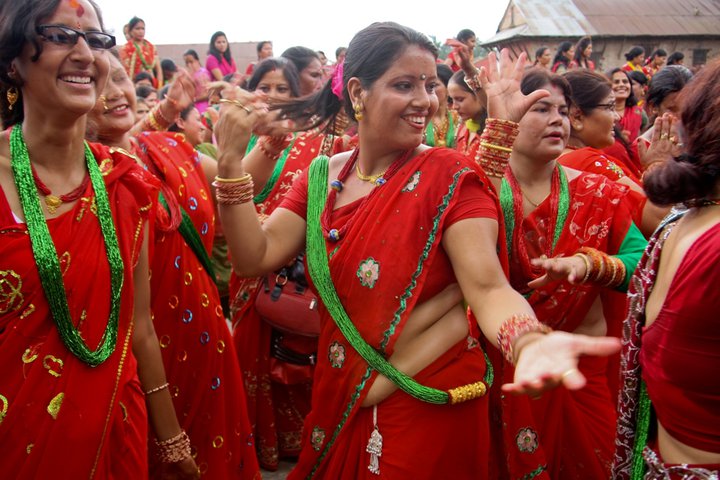 Teej falls on the third day of the waxing moon in the Nepali month of Bhadra, as per the lunar calendar, and its roots in Hindu mythology trace back to the sacrifices the goddess Parvati made as part of her devotion to Lord Shiva. Shiva then represents the ideal man, and on this occasion, women symbolically step into Parvati’s shoes, believing that if they too carry out designated rituals such as fasting and praying, it will translate to good fortune for their loved ones. Fasting and other associated rituals, however, appear to have fallen out of favour when it comes to many young Nepalis. This includes the kind of song and dance routines that were a big part of the celebrations in the past. “Before, women would get together and dance to old folk songs,” says Astha Neupane, a young professional. “Now they have all these modern tunes that they prefer and these don’t really gel with the mood of the festival.” Subedi attributes this to the kind of cultural education children receive while growing up, and says that while her mother’s generation was more or less taught to respect tradition and sustain rituals as a child, families nowadays give very little priority to that sort of thing, and it’s “no wonder” that girls have become very much detached from their roots. “Nothing is wrong with moving with the times, but that shouldn’t mean you forget where you came from,” she says. Bipula Khanal, a marketing officer, on the other hand, doesn’t think all is lost yet. “It’s unfortunate that modernity threatens to wipe out age-old traditions, but there is still time to if not reverse, at least stem that flow,” she says. “If we’re able to give girls an idea of the significance of Teej, and school them in all its traditional values as well as its fun aspects, I think we could get them on board.”
 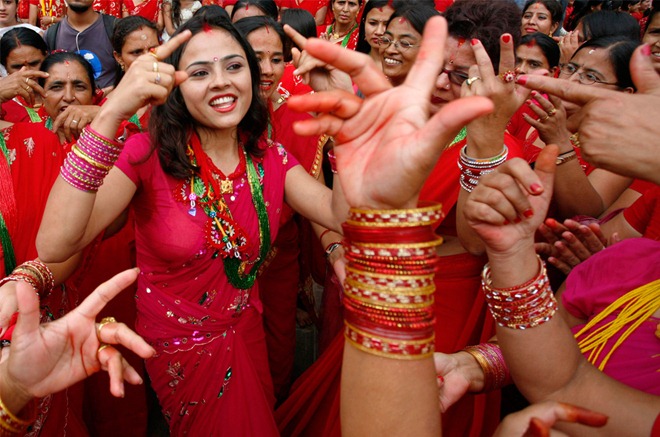 It is clear from my conversations with these women that Teej hasn’t altogether lost its touch when it comes to its place in Nepali culture. Of course, many young women appear to have distanced themselves from the true significance and meaning of the festival, but that is perhaps a given in this modern age. It is at least reassuring to know that there are still many out there who do strive to preserve tradition and who will ensure that Teej will continue to be celebrated in the years to come. source:ekantipur
Share this article
A
admin
Crafted for travellers who want grounded planning insight, mountain context, and a clearer feel for the journey before they go.