When Sir Edmund Hillary and Tenzing Norgay reached the top of Mount Everest in 1953, it was arguably the loneliest place on Earth — an oxygen-deprived desert perched atop an icy, 29,000-foot ladder of death. Over the las
When Sir Edmund Hillary and Tenzing Norgay reached the top of Mount Everest in 1953, it was arguably the loneliest place on Earth — an oxygen-deprived desert perched atop an icy, 29,000-foot ladder of death. Over the last 62 years, more than 4,000 climbers have replicated the pair’s feat, with hundreds more attempting to do so during the two-month climbing season each spring, according to the Associated Press. Along the way, people have left oxygen canisters, broken climbing equipment, trash, human waste and even dead bodies in their wake, transforming the once pristine peak into a literal pile of … well, you get the idea. “The two standard routes, the Northeast Ridge and the Southeast Ridge, are not only dangerously crowded but also disgustingly polluted, with garbage leaking out of the glaciers and pyramids of human excrement befouling the high camps,” mountaineer Mark Jenkins wrote in a 2013 National Geographic article on Everest.
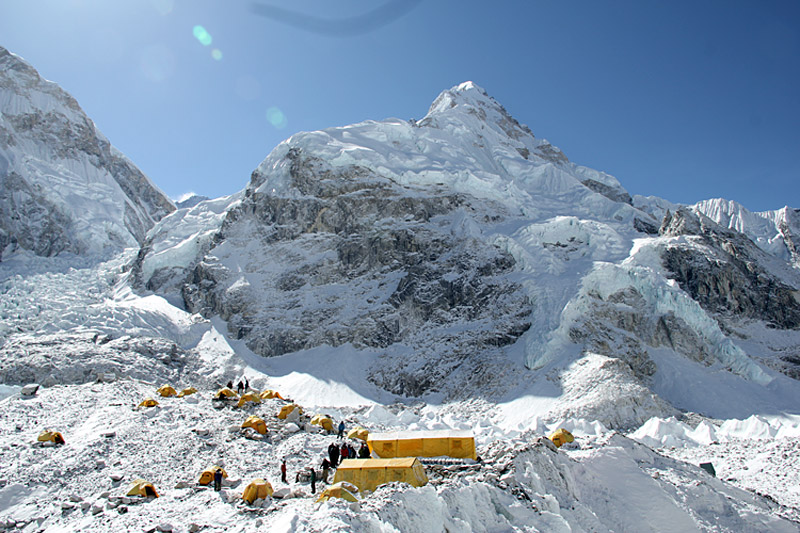
This week, Ang Tshering, president of Nepal Mountaineering Association, warned that pollution — particularly human waste — has reached critical levels and threatens to spread disease on the world’s highest peak. At base camp, the Associated Press reported, climbers have access to toilet tents with drums that are carried to lower areas and properly disposed once they are full. “Climbers usually dig holes in the snow for their toilet use and leave the human waste there,” Tshering told the AP, noting that the waste has been “piling up” for years around the four camps, where climbers spend weeks acclimatizing to the high altitude without access to toilets. The warnings aren’t new. This, for instance, is from a 2012 Washington Post opinion piece by Grayson Schaffer, an editor for Outside magazine:
 Sherpas spend time near their tents. (Phurba Tenjing Sherpa/Reuters file)
Everest even has a sewage problem. When base camp’s outhouse barrels are filled, porters haul them to open pits near Gorak Shep. Meanwhile, above base camp, most climbers straddle small crevasses to relieve themselves. The result: The peak has become a fecal time bomb, and the mess is gradually sliding back toward base camp. In 2012, Swiss climber Ueli Steck told me that he won’t even boil snow for water at Everest’s Camp II, because he thinks the lower boiling temperature at that altitude won’t kill germs.So, how much waste are we talking about? As much as “26,500 pounds of human excrement” each season, “most of it bagged and carried by native Sherpas to earthen pits near Gorak Shep, a frozen lake bed and village at 16,942 feet,” according to Grinnell College. As Sherpa Pemba Nima told SummitClimb.com when asked about pollution coming from the Everest base camp, the problem extends beyond the mountain to the watershed below.
“Ohh… awful… Pollution everywhere. Our main water source has been polluted. The dumping site is along the main trail to EBC, sometimes our local animals (yaks) fall into the pit. Even though it has been moved to different location now, I think it takes so many years to disintegrate because of the cold climate the pollution will remain there for many years.”There are people fighting to clean up the mounting piles of trash. Dawa Steven Sherpa, who has been leading Everest cleanup expeditions since 2008, told the AP that some climbers carry disposable toilet bags with them at higher altitudes. A group of Nepali artists has collected 1.5 tons of Everest trash — including remnants of a crashed helicopter — brought down by climbers and transformed it into 74 pieces of art, according to CNN. And yet, the Everest Summiteers Association, which has also collected tons of debris from the mountain, estimates there might be as much as 10 tons of trash left on Everest — a figure that is only expected to grow, according to Time. Last year, the Nepali government instituted a new rule requiring each climber to bring 18 pounds of trash off the mountain — “the amount it estimates a climber discards along the route,” according to the AP. Climbing teams that don’t comply forfeit their $4,000 deposits. “Each expedition to Everest is required to take a garbage deposit and bring their waste back,” Everest Summiteers Association general secretary Diwas Pokhrel told CNN. “But this system has not been strictly implemented.” Source: the washington post
Tags:
#Decades of human waste have made Mount Everest a ‘fecal time bomb’
#Mt Everest
Share this article
B
binu
Crafted for travellers who want grounded planning insight, mountain context, and a clearer feel for the journey before they go.