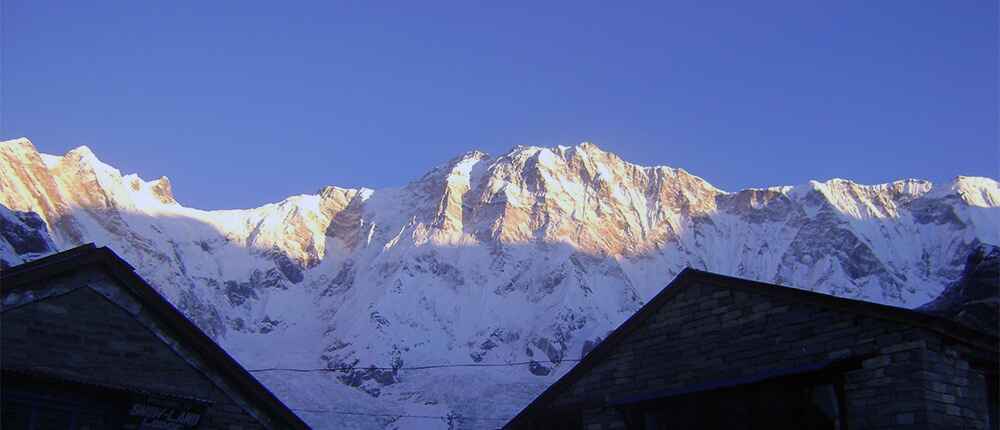
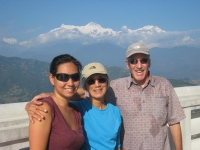
Annapurna Base Camp Trek is one of the most popular, moderate, and classic treks in Nepal and Short Annapurna Base Camp trek is the shorter version of this classic base camp trek. It’s the most direct route that leads you to the base camp located at the altitude of 4,130 meters above sea level, in the Annapurna Sanctuary. This base camp trek, surrounding you with 360 degrees, jaw-dropping panorama of Annapurna III (7,555m), Annapurna South (7,219m), Gangapurna (7,455m), Machhapuchare (6,993m), Baraha Shikhar / Annapurna Fang (7647m), Hiunchuli (6441m), and Singu Chuli (Fluted Peak) (6,501m), also allows you to stand face to face with the 10th highest mountain on earth, Annapurna I (8,091m).
This trek, starting Jhinu, takes you through the dense forest of Rhododendron, Oak, Cedar and Bamboo that starts around Chhomrong and continues till Deurali. However, the trek onwards from Deurali to the Annapurna Base Camp is above the treeline, in a more exposed area with only fewer trees and alpine meadows and the trail is rocky and barren and dotted with glacial streams, boulders and the distinct moraine formations left by old glaciers. . The view of Machhapuchhre dominates most parts of this Annapurna Base Camp trekking trail. However, apart from the views of the mountains, lush green forest, waterfalls, streams and other natural elements, this trek provides ample opportunity to delve into the lifestyle and rich culture of the inhabitants (especially Gurung people).
Adventure Mountain Explore Treks and Expedition’s 9 days Short Annapurna Base Camp Trek starts with your arrival in Kathmandu and ends with your departure from Kathmandu. You will spend 2 nights in Kathmandu, 2 nights in Pokhara and the remaining nights in the Annapurna region, trekking to and from the base camp. The trek starts with a drive to Jhinu from Pokhara. The trail will take you through Chhomrong, Sinuwa, Bamboo, Dovan, Himalaya, Deurali and the Machhapuchhre Base Camp to the base camp of Annapurna. The return trek is on the same trail. The average walking hour on this trek is 6-8 and the elevation gain each day is always below 1000 meters.
Hence, this trek is perfect for any physically fit trekker with limited time, but looking for a high-altitude base camp adventure.
If you are already in Pokhara you can also choose to join the group or start the trek from Pokhara.
The best time to enjoy this trek is March to May and October to early December. If you can stand cold weather, this trek can also be done from December to February, which makes it a perfect off-season Annapurna trek.
Moreover, if you are looking for an extended Annapurna Base Camp Trek, we highly recommend adding Ghorepani and Poon Hill to the itinerary and go for our 13 days Annapurna Base Camp Trek.
But, if you are looking for other short treks in the Annapurna region with great Himalaya Views in Nepal, we highly recommend Ghorepani Poon Hill Trek, Mardi Himal Trek or a little longer Ghorepani Poon Hill with Ghandruk Trek.
Trip Includes
- Airport transfer service upon arrival and departure (private car/jeep/minivan-depending on the group size)
- 2 Nights twin-sharing accommodation with breakfast in Kathmandu (3 Star Standard Hotel). Upgrades available at extra cost.
- 2 Nights twin-sharing accommodation with breakfast in Pokhara (3 Star Standard Hotel).Upgrades available at extra cost.
- Luxury tourist bus transportation Kathmandu-Pokhara-Kathmandu (Private car/jeep/minivan or flight can be arranged at extra cost)
- Shared jeep transportation from Pokhara to Jhinu and Jhinu to Pokhara
- All required trekking permits
- Meals (breakfast, lunch and dinner), during the trek
- 3 cups tea/coffee (served in cups only) during the trek
- Seasonal fruits served after dinner during the trek
- Purified drinking water (unlimited) during the trek
- All accommodation on twin-sharing (except at Deurali and ABC) basis in normal standard lodges during the trek
- One government-licensed, English-speaking, knowledgeable and experienced guide and his entire expenses (Guide-Guest ratio 1:6)
- One porter (for each two trekkers) and his entire expenses
- Insurance of guide and porter
- All required local and government taxes
- Duffle bag and trekking route map (souvenir)
- Down Jacket and sleeping bag (if required)
- Adventure certificate on completion of the trek
- Basic First Aid Kit
- Farewell dinner
Trip Excludes
- Nepal arrival visa
- Lunch and dinner (except farewell dinner) in Kathmandu and Pokhara
- Personal expenses such as mineral water, alcoholic/non-alcoholic beverages, extra meals, hot water for drinking or any other purposes, laundry service, any other drinks except tea and coffee etc.
- WiFi, battery charging and hot shower services etc.
- Private transportation-car/jeep/minivan/bus (depending on group size) to and from Pokhara (can be arranged at extra cost)
- Flight to and from Pokhara (can be arranged at extra cost)
- Any extended trips, accommodation and meals
- Meals and accommodation in Pokhara and Kathmandu in case of early return from the trek
- Any adventure activities like bungee jumping, paragliding, hot air balloon ride, rafting, zip lining, cable car ride, ultralight flight in Pokhara (can be arranged at extra cost)
- Travel insurance that covers helicopter evacuation over 4000 meters, trip cancellation and the treatment cost caused by unforeseen illness/disease/situation
- Tips (as an appreciation) to the service provider
Useful Information
Travel Insurance
If you are planning your next trek in Nepal, the first thing we recommend you to do is to get a travel insurance. Along with the cost of the entire activities that you are planning to do, during your stay in Nepal, your insurance policy should also cover additional expenses that might result due to various health issues, injuries or accidents (including air ambulance, helicopter rescue and other treatment cost). Additionally, the policy should also cover death, misplaced luggage, theft and liability, cancellation, medical treatment (including hospital charges, cost of the medicine and doctor’s fee). We also request you to make sure that your policy covers the treks that go over 4000m.
Health, fitness and experience requirements:
Although this trek is considered as a moderate and an easily attainable trek, excellent stamina, strong determination and the best health conditions are always the plus points, as some sections of the trek are a little demanding and some days might even require long hours of walking. Therefore, before scheduling your trek, we recommend you to get a health check up and take expert guidance from your local General Practitioner regarding the necessary guide walks, before the trek. However, in the absence of GP, we recommend you to seek advice from a travel clinic.
Moreover, this trekking in Nepal does not require any technical skill. However, your prior hiking or camping experience will definitely be considered as a plus point. Nevertheless, we recommend a few weeks of regular exercise and jogging to build up the required stamina.
We also kindly request you to inform us regarding your present health condition, medical situation, preceding illness and the medications you are taking. We expect you to be honest regarding these issues, so that we can get prepared to take quick action during the emergencies.
Food and Accommodation:
This package ensures the benefits of the full board (meal –breakfast, lunch, dinner and tea/coffee and accommodation),during the trek. The breakfast will usually be western and served in the accommodation. Traditional Nepali food will be served for lunch in one of the tea houses on the way. Dinner will also be a traditional Nepali food and will be served in the accommodation itself. Western lunch and dinner can be served on request, if available. However, before and after the trek, the package only ensures bed and breakfast in Pokhara. Accomodation during the trek is arranged in a lodge/guest house/tea house. Usually the rooms are twin-share with shared amenities, where you will have to share your room with another member of your group. Triple share can be arranged on request, however, if you are looking for a single supplement, extra charges will be applicable. In Pokhara, your accommodation is arranged in a tourist standard hotel (on a twin-share basis).
Our attempt while you are on a trek:
Although, communication facilities in this region are less compared to the cities in Nepal, we make all the arrangements to meet your communication needs, sot that you can be in touch with your family and friends, during the trekking. Internet facilities (paid) are available around some of our overnight stops. However, at places where internet services are not available, Adventure Mountain Explore Treks and Expedition takes the responsibility to deliver your message to your friends, family or any other concerned person. For this, you can use a cell phone provided to our guides to send your message to us, which will further be delivered to the respected person.
We can also help you reschedule your international flight (extra charges applicable), if you need any additional days to complete your trek. We will try our best to make this trek your one time life time experience.
Why choose us?
Adventure Mountain Explore Treks and Expedition is one of the leading tour and trekking organizers in Nepal. Utilizing years of experience, we will plan an outstanding adventure trip for you. Our trip packages are fully customizable; therefore, it can be customized to your needs and requirements. Our partnership with local Sherpas and leaders will help you get the maximum out of the trip. Customer service is our top priority; therefore, we cater to every possible need of yours, during your stay in Nepal, whether its food, accommodation, varied destination or a communication need. All our package rates are available at the unbeatable price.
Our legal documents:
Registered under the government of Nepal, Adventure Mountain Explore Treks & Expedition P. Ltd. is a fully licensed and certified company. Therefore, this company holds complete authority to operate treks, tours, expedition, hiking and many other tourism related services in Nepal, Tibet and Bhutan. In addition to this, we are also a very active member of the following organizations.
Nepal Tourism board (NTB)
Trekking Agents Association of Nepal (TAAN)
Kathmandu Environment Education Project (KEEP)
Ministry of Finance, Department of Taxation
Company Registration Office, Pvt. Ltd.
Ministry of Tourism and Civil Aviation, Department of Tourism Industry
What are the best seasons to plan this trek?
Spring – March, April and May are considered as the best months to plan the Annapurna Base Camp trek as you can enjoy the warmest weather of the year, fine temperature, clear blue sky and the beautiful rhododendron forest.
Autumn – Mid September, January and February are also considered one of the best months to plan your trek to the Annapurna Base Camp as these offer the best trails, clear blue sky and the best visibility.
Winter – December, January and February are also considered as good months to plan your trek to the Annapurna Base Camp; however, its midwinter and days are very cold. Therefore, a very good preparation has to be made if you are planning your trek at this time of the year.
Summer – Mid June, July and August, monsoon in Nepal, is not considered as the best season to plan your trek in Nepal. The trails are slippery and the heavy rain usually affects the visibility.
What should I bring?
Along with warm clothes you will also need other equipment for the sufficient protection of your body. Below are the list of necessary items that you need to pack before commencing your trek.
Head- Hat (with a wide brim), Sunglasses (with UV protection), Sunscreen lotion and Lip balm.
Upper body- T-shirts (2), light and expedition weight thermal tops, Fleece jacket and pullover, Fleece wind-stopper jacket (Optional), waterproof (preferably breathable fabric) shell jacket, down vest/jacket (included)
Hands - Lightweight gloves, heavy-weight gloves/mittens with a waterproof outer shell
Lower body- Underwear (4), hiking shorts (2), lightweight cotton long pants, light and expedition weight thermal bottoms, Fleece or wool pants, waterproof (preferably breathable fabric) shell pants
Feet- Thin, light-wear inner socks (4), thick, warm wool hiking socks (4), hiking boots with spare laces, camp shoes (sneakers and/or sandals), gaiters (only for winter)
Accessories- Sleeping bag rated to zero degrees F (included), headlamp with spare bulb and batteries, small padlock or combination lock, basic first aid kit, large plastic bags (for keeping items dry inside trek bag), day pack, water bottles (2), hiking pole/walking sticks, small ear plugs
Toiletries– Soap, shampoo, toothbrush, small wash towel
Extras- Cameras with extra batteries and cards, binoculars, light balaclava or warm fleece hat, reading books, trip map/guide book, journal & pen, iPod & travel games (like cards, chess, backgammon)
Passport and Visa Information:
It is very easy to obtain Nepal’s visa. You may either apply for a visa at your nearest Nepalese Embassy/Consulate or Mission offices in your own country, or you can buy this upon your arrival at Tribhuvan International Airport in Kathmandu. To apply for a visa, you need 2 passport size photographs, Visa fees in US dollars and your passport that is valid for at least 6 months before the trip. However, nationals of SAARC countries (India, Bhutan, Sri Lanka, Pakistan, Bangladesh, Maldives and Afghanistan) and China do not require any visa to visit Nepal. Transit visa for foreign nationalities is only provided for 3 days. Therefore, visa is required for longer stays. However, for the convenience or foreign nationals, a visa is also provided from the borders listed below:
Tribhuvan International Airport (Kathmandu)
Kakarvitta, Jhapa (Eastern Nepal)
Birgunj, Parsa (Central Nepal)
Kodari, Sindhupalchowk (Northern Border of Nepal)
Belhiya, Bhairahawa (Western Nepal)
Jamuna, Nepalgunj (Mid Western Nepal)
Mohana, Dhangadhi (Far Western Nepal)
Gaddachauki, Mahendranagar (Far Western Nepal)
Tourist Visa Fees:
Transit visa (3 days) – Free of cost
Multiple entry (15 days) – 30 USD or equivalent convertible currency
Multiple entry (30 days) – 50 USD or equivalent convertible currency
Multiple entry (90 days) – 125 USD or equivalent convertible currency
(For more information, please contact the Department of Immigration, Maitighar, Kathmandu.
Tel: 00977-1 4221996/4223590/4222453. You can also download visa form from – www.immi.gov.np)