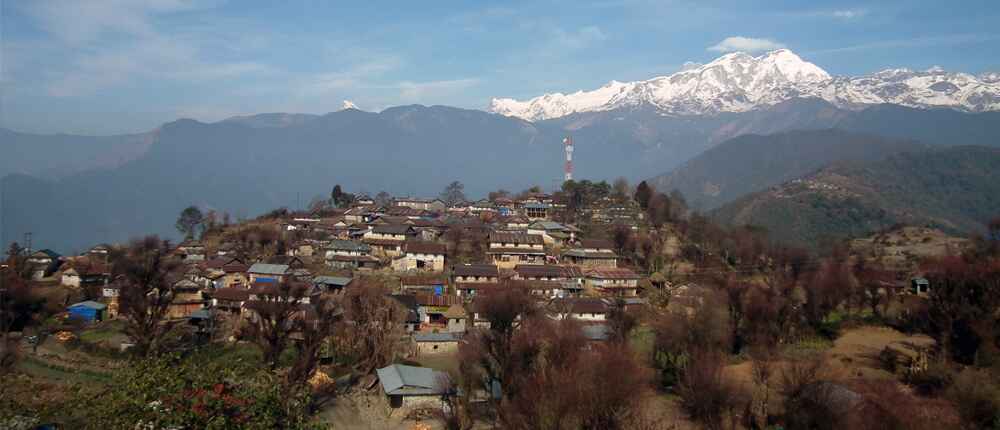
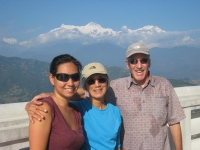
The Ghale Gaun trek is the perfect trek in which to experience the unique lifestyles of the Gurung (the world-famous Gurkha soldiers), along with panoramic views of snow-cappedmountains. This is just off course of the crowded trekking route to the famous Annapurnas; this route runs northwest of the Annapurna trail. The route splits from Khudi and leads to the beautiful, traditional village of Ghalegaun, which is located at an altitude of 2020meters above sea level. Traditional cultural practices are still followed by the locals during births, deaths, marriages and in other ritualistic activities. Locals perform old cultural dances such as Jyaure, Serka, Dohori, Ghatu, Sorathi, Jankri etc. on various occasions by using different musical instruments along with traditional, unique dress. The trail also leads you through the forest of rhododendron flowers, past waterfalls, and through many more traditional villages along the way.The walking on this trek is not very tiring.
Even with all of the amazing sights mentioned above, the natural beauties are truly the main attractions of this trek. You will have majestic views of the Himalayas, such as Machhapuchhare(6693m) Annapurna II (7939m), Annapurna(8091m), Annapurna IV (7525m), Lamjung Himal, Himalchuli (6747m), Bouddha Himal (6974m) and many more snowy mountains. This trip grants you perfect memories of traditional cultures with their warm hospitality as well as memories of the great views of the Himalayas, which will remainin your heart throughout the rest of your life.
Trip Includes
-Airport pick up and drop by private vehicle
-3 Nights twin sharing accommodation in Kathmandu at tourist standard hotel with breakfast
-One full day guided city tour by private vehicle
-Welcome dinner and farewell dinner at one of the best Nepalese restaurant with traditional ethnic music and dance
-Annapurna trekking permits and Tims permits
-Bus transportation to Besisahar/Khudi and return
-Breakfast in the city and full meals during the trek and jungle safari
-Gov. licensed and well trained English speaking guide and his entire expenses
-A porter (One porter for each 2 members) and his entire expenses
-nsurance of Guide and Porter
-All required local tax and Gov tax
-Down jackets and sleeping bags
Trip Excludes
-Nepal arrival visa
-Meals in the city except breakfast and above mentioned special dinner
-Monument entrance fees
-Your personal nature expenses eg. Mineral water, Beer, Coke and entire beverage etc
-Travel insurance that covers trip cancelation and Helicopter evacuation
-Tips and any other extending trips and accommodation.
Useful Information
Nepal is a land located country which lies in between India and China. It is one of the richest countries in the world in terms of bio-diversity due to its unique geographical position and altitude variation. The elevation of the country ranges from 60 meters above sea level to the highest point of the world, Mt. Everest at 8,848 meter above sea level. Nepal is small country but many interesting things to see. Nepal is the second richest country in the world in terms of water resources. We have beautiful Himalayan range in the north and have many rivers begins from the Glacier of the Himalaya. Nepal has three major geographical range Himalayan region, Hill region and Terai low land.
Area: 147,181 sq. kilometers
Geography: Situated between China in the north and India in the south
Capital: Kathmandu
Population: 2,642,799
Language: Nepali is the native language. However, travel-trade people understand and speakEnglish as well.
Currency: Nepali Rupee
Political System: Multi-party democracy
Religion: The major number is Hindu. However, there is a harmonious blending of Hinduism and Buddhism.
Travel season: We do have two best seasons to visit Nepal. We always suggest you to come at the right time of the year as far as possible. So the best time is Spring and Autum.
Spring: - (March, April, May) - Best warmest time to trek. Rhododendron flowers in bloom excellent trails and clear skies, best visibility. Good Temperature, warmest weather of the year.
Autumn: - (Mid September, October and November) - excellent trails, clear blue skies, best visibility.
Winter months: - (December, January and February) are also good, but it’s obviously colder. You have to be prepared for this.
Summer: - Monsoon, so rain and visibility can be a big issue (from Mid June, July and August).We do not suggest you this time to visit Nepal. Nepal can be visited the whole year round.
People: Nepal has more than 91 ethnic groups and 70 different spoken languages.
What to Wear: Lightweight clothing is recommended for May through October. Warm garments are required in October through March. An umbrella or raincoat is a must for the rainy season (June to August)
Climate: Nepal’s climate varies according to elevation. The Terai of southern Nepal has a tropical monsoon climate characterized by rainy summers and the southwest winds of the monsoon, and almost dry winters. The effect of the southern monsoon climate extends
northward into mountain valleys. In the Middle Himalayan valleys the amount of precipitation varies with the extent of exposure to the rain-bearing monsoon winds. Several high valleys located in the rain shadow (area where precipitation is partially blocked by mountains) are dry. In the Kathmandu Valley the average rainfall is about 2,300 mm (about 90 in), most of which occurs from June to September. Between elevations of about 500 and 2,700 m (about 1,640 and 8,860 ft) there is a warm temperate climate; between about 2,700 and 3,000 m (about 8,860 and 9,840 ft) a cool temperate climate prevails. Between about 3,500 and 4,100 m (about 11,480 and 13,450 ft) summers are cool and winters are very cold. Above 4,100 m (about 13,450 ft) a severely cold, alpine climate prevails.
Communication:
Postal Services: The Central Post Office located near Dharahara Tower, is open from 9 a.m. to 5 p.m. Monday through Friday. The counters are open from 7 a.m. to 4 p.m. and provide stamps, postcards and aerogram. Post Restate is available Monday through Friday from 9 a.m. to 5 p.m. Express Mail Service (EMS ) is available at GPO and at Thamel, Basantapur and airport postal counters.
Telephone Services:
Telephone, fax, telex and telegraph services are available at the Nepal Telecommunications Corporation at Tripureshwar. Hotels and private communications centers provide long distance telephone. For calling from outside, country code for Nepal is 00977 and the area code for Kathmandu is 1. Nowadays anyone can buy a local Sim card to use while in Nepal (2 passport size photos and passportvisa copy).
Internet Services:
Several Internet cafes and communication centers have opened up in the Valley and around the country in the past few years. Visitors only have to find a place they are most comfortable in to use the facilities to keep in touch with home. E-mail and Internet services are also offered by hotels in the city like Kathmandu, Pokhara, Chitwan and more major cities.
Electricity:
Major towns have electricity and the voltage available is 220-volts and 50 cycles. Load shedding is sometimes experienced. However, most major hotels have installed their own generators.
Medical Services:
All kinds of medicines, including those imported from overseas are available in Kathmandu. Kathmandu Valley also offers the services of major general hospitals and private clinics. Health posts have been set up by the government in different parts of rural Nepal.
Meals and Accommodation:
In the big cities, here are many different categories hotels (From tourist standard to star level) are available. There are many different restaurants in the city as per your interest. While you are on mountain especially for the trek basic mountain accommodations are available where basic facilities are available such as hot shower, toilets, comfortable mattress, solarelectricity lights.
Insurance:
A travel insurance policy that covers theft, loss and medical treatment is recommended. Make sure the insurance also covers the activities that you will be undertaking during your stay in Nepal such as trekking, rafting.
Vaccination:
Vaccination is required to plan to your trip to Nepal but it is not a must to have thing to come, but highly suggested. Your doctor will have the information of vaccination you would require to the country where you will be travelling. Hepatitis A, Japanese Encephalitis, Polio, Rabies, Tetanus, Typhoid and Malaria etc. are the recommended vaccination for travel Nepal.
Medical Kit:
A simple but adequate medical kit can be very useful while traveling. The following items are recommended: Aspirin or Panadol - for pain or fever; Antihistamine - as a decongestant for colds, allergies and to help prevent motion sickness; Antibiotics - useful if traveling off beaten track but they must be prescribed; Kaolin preparation (Pepto-Bismol), Imodium or Lomotil – for stomach upsets; Rehydration mixture - for treatment of severe diarrhoea; Antiseptic, mercurochrome and antibiotic powder or similar 'dry' spray - for cuts and grazes.
Other things to be included are:
Calamine lotion to ease irritation from bites or stings, bandages and band aids for minorinjuries, scissors, tweezers, thermometer, insect repellent, sun block lotion, chopsticks, water purification tablets, throat lozenges (Strepsils), moleskin, Sulamyd 10% eye drops, Acetaminophen (Paracetamol, Antacid tablets).
General Knowledge:
It would be hard to know all aspects of Nepal’s health problems. However, it would be useful togather information on altitude sickness (AMS), diarrhoea, giardia, dysentery, cholera, hepatitis rabies, typhoid, tetanus, meningitis diphtheria, malaria and HIV/AIDS Common sense can often save lives.
Pack list:
It is essential to have warm clothing and equipment to plan this trip. Here below are some suggestions for planning this trip. Please kindly take it as a reference and prepare yourself.
Climbing:
Ice Axe
Crampons
Harness
Screw gate Carabineers
Descended abseil device
Prussic Loops
Plastic Mountaineering Boot
For your head:
Sunglasses with UV protection
Lip balm
Upper body:
T- Shirts (2)
Light and expedition weight thermal tops
Fleece jacket or pullover
Fleece Wind-Stopper jacket (optional)
Waterproof (preferably breathable fabric) shell jacket
Down vest and/ or jacket
Hands:
Lightweight gloves
Heavyweight gloves/ mittens with a waterproof outer shell
Lower body:
Underwear (4)
Hiking shorts (2)
Lightweight cotton long pants
Light and expedition weight thermal bottoms
Fleece or wool pants
Waterproof (preferably breathable fabric) shell pants
Feet:
Thin, lightweight inner socks (4)
Thick, warm wool hiking socks (4)
Hiking boots with spare laces
Camp shoes (sneakers and/ or sandals)
Gaiters (when hiking in winter)
Accessories:
Sleeping bag rated to zero degrees F
Headlamp with spare bulbs and batteries
Small padlock or combination lock
Basic First Aid Kit
Large plastic bags- for keeping items dry inside trek bag
Daypack (you will carry your own small daypack)
Water bottles (2)
Hiking poles/ walking sticks
Toiletries:
Soap, shampoo, toothbrush, toothbrush etc
Ear plugs
Small wash towel
Extras:
Camera with extra batteries and cards/ film
Binoculars
Sun hat or scarf
Light balaclava or warm fleece hat
Reading book
Trail Map/ Guide book
Journal & Pen
IPod & Travel games (i.e. cards, chess, and backgammon)
Passport & Visa Information
Nepal visa is the easiest visa to obtain; you may buy your Nepal visa at your nearest NepaleseEmbassy/ Consulate or Mission offices abroad or buy this upon on arrival to Kathmandu international airport as per your convenient. You have to have 2 passport size photographs, Visa fees in US cash & valid passport at least for 6 months valid at the starting of the trip. Nationals of SAARC countries and China do not need visa when visiting Nepal. As per this rule, Indian nationals do not require visa. Transit visa is provided for foreign nationality for 3 days. Visa must be obtained for staying over the initial period of three days. Currently, foreign national can obtain Nepalese visa from the following border.
• Tribhuvan International Airport, Kathmandu
• Kakarvitta, Jhapa (Eastern Nepal)
• Birganj, Parsa (Central Nepal)
• Kodari, Sindhupalchowk (Northern Border)
• Belhiya, Bhairahawa (Rupandehi, Western Nepal)
• Jamuna, Nepalgunj (Banke, Mid Western Nepal)
• Mohana, Dhangadhi (Kailali, Far Western Nepal)
• Gaddachauki, Mahendranagar (Kanchanpur, Far Western Nepal)
Tourist Visa Fees
3 days transit visa - Free of cost
Multiple entry 15 days US$ 30 or equivalent convertible currency
Multiple entry 30 days - US$ 50 or equivalent convertible currency
Multiple entry 90 days - US$ 125 or equivalent convertible currency
(For further information, please, contact Department of Immigration, Kalikasthan, Dillibazar, Kathmandu
Tel: 00977-1 4433934 / 4429660 / 4438862 / 4438868, Download visa form-: www.immi.gov.np