Planning a trek in the Nepal Himalayas is exciting, but let’s be honest, the breathtaking views come after a fair bit of hard work. Whether you’re trekking to Everest Base Camp, Annapurna Circuit, Langtang, or Manaslu, o
Planning a trek in the Nepal Himalayas is exciting, but let’s be honest, the breathtaking views come after a fair bit of hard work. Whether you’re trekking to Everest Base Camp, Annapurna Circuit, Langtang, or Manaslu, one thing is common: you need to be fit for the altitude, the trails, and the long walking hours.
This Trek Fitness Guide for Himalayan High-Altitude Treks is designed to prepare you for everything from easy treks to challenging expeditions.Why Fitness Matters for Himalayan Treks
High-altitude treks in Nepal usually range from 2,500m to over 5,500m. At these altitudes:- Oxygen levels drop significantly (up to 50% less than sea level).
- Your body works harder even on gentle climbs.
- Long walking days (6–8 hours) demand strong stamina.
How Fit Do You Need to Be for Himalayan Treks?
Your required fitness depends on your trek difficulty:- Easy Treks (e.g., Ghorepani Poon Hill, Mardi Himal lower sections): Walk 4–5 hours daily, moderate climbs. Basic fitness is enough.
- Moderate Treks (e.g., Annapurna Base Camp, Langtang Valley): 5–7 hours of walking daily, with steep ascents/descents. Requires good endurance.
- Difficult Treks (e.g., Everest Base Camp, Manaslu Circuit, Upper Mustang): 6–8 hours walking at high altitude. Demands strong cardio and leg strength.
- Strenuous/High Pass Treks (e.g., Everest Three Passes, Kanchenjunga, Dolpo): 8+ hours, high altitude above 5,000m, multi-week trekking. Excellent stamina and prior trekking experience recommended.
Step-by-Step Fitness Training Plan for Your Trek
- Cardio Training (Endurance Building)
- Jogging or running (start slow, build up distance).
- Brisk walking with a backpack.
- Cycling or swimming for a variety.
- Strength Training (Muscle Power for Climbs)
- Squats, lungs, step-ups (build leg power).
- Planks, push-ups, sit-ups (core stability).
- Deadlifts or weighted exercises (if gym access available).
- Flexibility & Mobility (Injury Prevention)
- Yoga or stretching routines.
- Hamstring, calf, and hip stretches.
- Shoulder mobility (for backpack comfort).
- Altitude Preparation (Simulating Trek Conditions)
- Train with a weighted backpack (5–8 kg).
- Practice stair climbing or hill walking for uphill endurance.
- If possible, do short high-altitude hikes near your home before Nepal.
8-Week Fitness Plan for Trek
Weeks 1–4: Building the Base- Start small and increase steadily: Week 1 – 2 km, Week 2 – 3 km, Week 3 – 4 km, Week 4 – 5 km. Keep your jog or brisk walk comfortable, without pushing for extra distance.
- For strength training, choose 4–5 basic exercises (squats, lunges, planks, push-ups, step-ups), do at least 10-12 repetitions and 3 sets of all the exercises mentioned
- Add 10 minutes of stretching or yoga daily to improve flexibility and avoid stiffness.
- Do not skip your rest days. Recovery is just as important as training.
- Increase stamina: aim to jog 5–6 km in about 35 minutes or cover 10 km of brisk walking in 2 hours.
- Once a week, train with a backpack weighing 5–8 kg, gradually extending the duration of your walk.
- Add strength training 3 times a week, focusing especially on legs (squats, lunges, step-ups) and core (planks, sit-ups, bridges). If you can easily do 10 repetitions and 3 sets of each exercise, increase your repetitions to 15 or 20 in each set.
- Include stair climbing sessions: climb the equivalent of 15 floors, repeat for 3 sets, resting in between.
- Go for a long practice hike once a week. Wear your trekking shoes and carry your backpack to simulate actual trail conditions.
A set is a group of those repetitions done together, and most workouts include repeating the same set a few times. For example: If you complete 10 push-ups in a row, that’s 10 reps. If you repeat this round 3 times, you’ve done 3 sets of 10 reps, making a total of 30 push-ups.
Fitness Plan for Difficult Treks
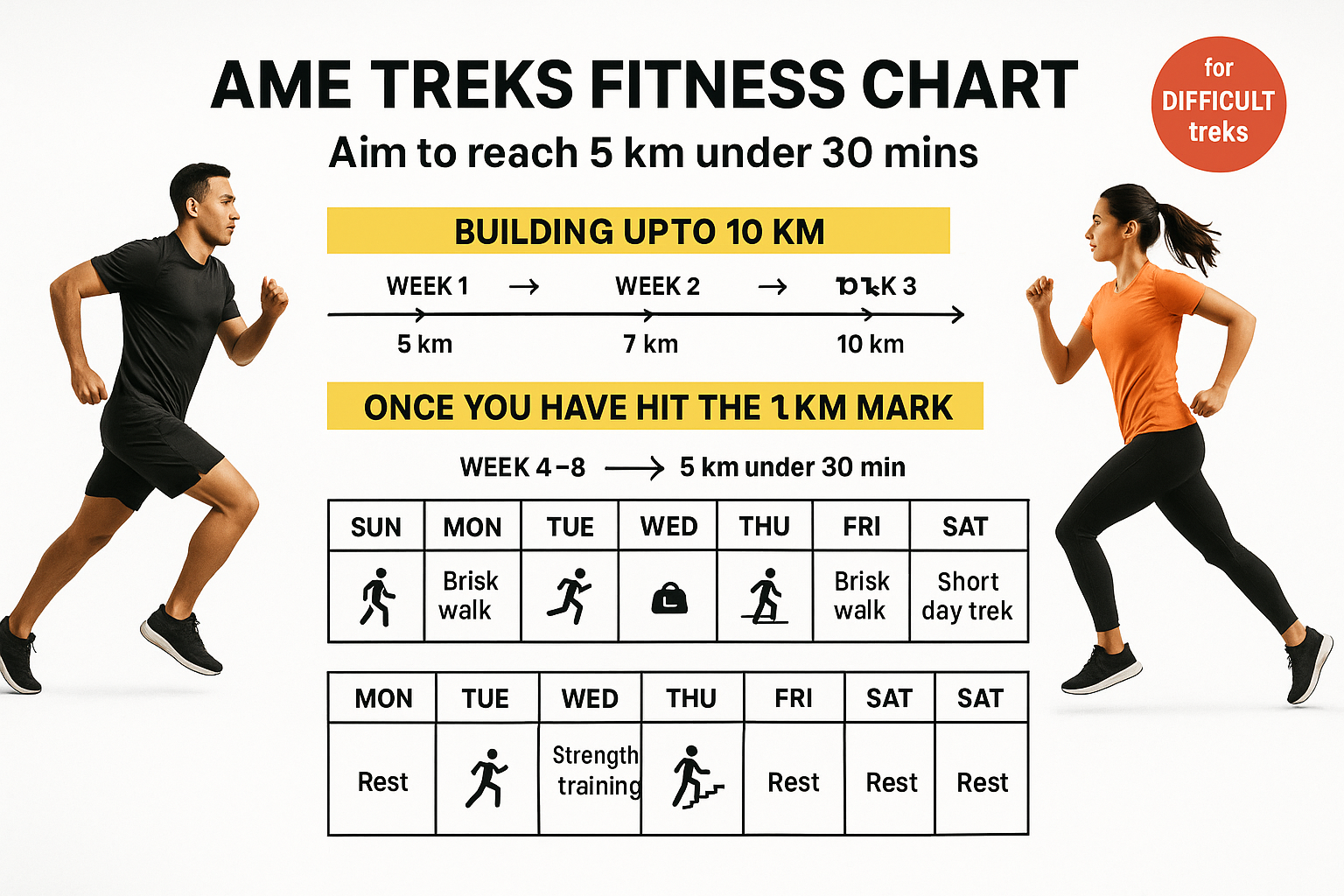
Difficult treks are the most demanding, often stretching over 12–20 km daily with very steep climbs and descents. You may reach altitudes above 19,000 ft, and technical sections, such as scree slopes, glacier walks, near-vertical ascents, boulder fields, and rockfall-prone areas, are a daily challenge. Many stretches can only be crossed under the guidance of trained technical staff. Because of this intensity, only trekkers with prior high-altitude experience are allowed to join. Before signing up, you’ll be asked to complete a questionnaire about your fitness and trekking background. To qualify, you should be able to run 10 km in 60 minutes consistently. This target is achievable only if you can first manage 5 km in 30 minutes with ease. The 8-week training schedule below is designed to help you get there. Weeks 1 - 4: Building Endurance- Running/Walking: Start with 5 km in Week 1, progress to 7 km in Week 2, and by Week 3 aim for 10 km. Keep your distance steady once you reach 10 km; avoid sudden increases.
- Strength Training: Perform at least 3 sets of 10 repetitions for all the exercises listed.
- Rest Days: Take them seriously, your body rebuilds and strengthens while resting.
- Stair Climbing: Climb at least 15 floors (20 steps per floor) per session, repeating 3 times.
- Running: Once you can cover 10 km comfortably, focus on speed. Aim to finish 10 km runs in under 60 minutes. If you’re not there yet, don’t worry, you should hit this goal by Week 8.
- Strength Training: Continue as before. If 10 reps × 3 sets feel easy, increase to 15–20 reps per set.
- Stair Climbing: Add an 8-10 kg backpack to increase intensity and continue for the next 4 weeks.
What to Do If You’re Short on Time
Sometimes trekkers join a group at the last moment, less than a month before the trek begins. This creates extra pressure on your training schedule. If you find yourself in this situation, don’t waste a single day. Begin training immediately and compress the schedule so that you can quickly reach the cardio benchmark of completing 5 km in 40 minutes.- Faster Progression: Instead of increasing your jogging distance by 0.25 km per day (as in the regular plan), increase it by 0.5 km daily.
- Start Easy: Begin with the slowest jog you can manage and see how far you can go without feeling overly exhausted.
- Build Gradually: Each following day, add 0.5 km more than the previous distance. Ignore the time for now; focus only on increasing distance.
- Rest Days: After 4 consecutive days of jogging, rest on the 5th day to let your muscles recover.
- Ongoing Routine: From Day 6 onward, jog 4 days in a row (adding 0.5 km each day), and rest every 5th day.
- Reaching 5 km: Once you hit 5 km, record the time it takes you. This becomes your starting benchmark. Continue maintaining this distance regularly until your trek begins, so your body adapts to the strain.
- Ideal: 5 km in 40 minutes (8 minutes/km pace).
- If you’re over 40 years old: 5 km in 45 minutes (9 minutes/km pace).
- Minimum requirement: At least 4 km in 32 minutes. This is the bare minimum, but the farther you can go, the stronger your endurance will be.
- Hydration practice: Drink 3–4 liters/day during training.
- Backpack training: Get used to the pack you’ll carry.
- Break-in your shoes: Avoid new shoes on the trek.
- Mental Preparation: Long treks test patience and resilience as much as fitness.
 FAQs on Trek Fitness in Nepal Can beginners do treks like Everest Base Camp?
Yes, with 8-12 weeks of proper training and gradual acclimatization, many first-timers succeed. Do I need a gym?
No, bodyweight exercises, running, and stair climbing are enough. How early should I start training?
At least 2 months before your trek. For difficult treks, aim for 3–4 months. Train Today, Trek Tomorrow! The Nepal Himalayas are rewarding, but fitness is your best trekking gear. With the right preparation, you’ll not only complete your trek, you’ll enjoy every moment of it. So, lace up your shoes, start training today, and get ready to experience the magic of Himalayan trekking with confidence and energy
FAQs on Trek Fitness in Nepal Can beginners do treks like Everest Base Camp?
Yes, with 8-12 weeks of proper training and gradual acclimatization, many first-timers succeed. Do I need a gym?
No, bodyweight exercises, running, and stair climbing are enough. How early should I start training?
At least 2 months before your trek. For difficult treks, aim for 3–4 months. Train Today, Trek Tomorrow! The Nepal Himalayas are rewarding, but fitness is your best trekking gear. With the right preparation, you’ll not only complete your trek, you’ll enjoy every moment of it. So, lace up your shoes, start training today, and get ready to experience the magic of Himalayan trekking with confidence and energy
Share this article
Bandana Gotame
Crafted for travellers who want grounded planning insight, mountain context, and a clearer feel for the journey before they go.