Everest Base Camp Winter Trek trekking in Nepal – AME Treks
Hard Nepal Himalayas 15 Days Signature Journey

Everest Base Camp Winter Trek

Kathmandu-Lukla-Phakding-Namche-Deboche-Dingboche-Lobuche-Gorakshep-EBC-Gorakshep-Kala Patthar-Gorakshep-Pheriche/Pangboche-Namche-Lukla-Kathmandu

4.9/5 (156 reviews)
5000 trekkers hosted
Duration
15 Days
Max Altitude
5550
Difficulty
Hard
Best Season
December, January and February
Group Size
2–12 People
Accommodation
Tea Houses

Product Description

A fuller introduction to the route, pace, terrain, and overall trip style.

15 days Everest Base Camp Winter Trek- Standard Package 

Introduction:

Everest Base Camp Winter Trek is a multi-day trekking journey to the South base camp (base camp in Nepal) of Mt. Everest in winter. December, January and February are winter months in Nepal. Therefore, winter Everest Base Camp trek is a trek to the base camp of the highest mountain in the world in one of these months. This trekking trail lies in the Khumbu region of northeastern Nepal and  takes trekkers to the base camp of Mt. Everest, which is  located at the altitude of 5,364m/17,598ft in the Sagarmatha National Park. This national park in Nepal is also one of the  UNESCO World Heritage Sites in Nepal.

Adventure Mountain Explore Treks and Expedition’s Everest Base Camp Winter Trek is a standard 15-day Everest Base Camp trek itinerary crafted for every high-altitude trekker, who wants to reach the base camp of Everest safely and comfortably, in winter - not a peak trekking time in Nepal. Therefore, if you are looking for December Everest Base Camp trek, January Everest Base Camp Trek, February Everest Base Camp Trek, or even off-season Everest Base camp trek, this package is designed for you. 

It’s a mid-budget trek in which you will fly to and from Lukla on a regular scheduled aircraft, stay in normal-standard lodges, be guided by an experienced, licensed and knowledgeable guide, and be assisted by local porters. The package also ensures adequate facilities and fair price to make it accessible to a wide range of trekkers. Lets explore further to know if this package fits your schedule, fitness and comfort level or not. 

This Everest Base Camp Winter Trek package is designed for:

  • Trekkers who can only manage to travel in December, January and February
  • First-time, high-altitude trekkers seeking practical and safe itinerary plan to get to the base camp of Mt. Everest. 
  • Trekkers who are comfortable hiking in cold temperatures and variable winter conditions
  • Adventurous traveler who prefer popular trekking trail, but at the time of the year when it’s not crowded
  • Physically fit trekker capable of trekking for multiple consecutive days at high altitude
  • Nature and mountain enthusiasts who value clear winter skies, dramatic Himalayan views and more remote experience 
  • Trekkers who prioritize meaningful trekking experiences over high-end amenities, understanding that accommodation options may be limited with some lodges closed in winter.
  • Trekkers who wish to celebrate special occasions, such as Christmas, New Year and Valentine’s Day in the Everest region or at the Everest Base Camp. 

This Winter EBC trek package is not designed for:

         x Trekkers seeking luxury accommodation or high-end services during the trek

         x Those not comfortable trekking in cold temperatures, snow or variable winter conditions

         x Anyone uncomfortable with basic facilities and shared amenities

         x First-time trekkers with no prior hiking or altitude experience

         x Anyone seeking groups but not flexible with travel dates - low season less groups to join 

         x Anyone with underlying health conditions that may be aggravated by high altitude or extreme cold

            conditions.

         x Trekkers with less than two weeks holiday.

Winter Everest Base Camp trekking route:

The 15 days Everest Base Camp Winter Trek itinerary begins with your arrival in Kathmandu. You will spend two nights in Kathmandu, before flying to the Everest region to start the trek. The immediately following day (Day 2) of the arrival day is the Kathmandu Valley sightseeing tour day, in which you will spend the day exploring the UNESCO World Heritage Sites in Kathmandu. The next morning (Day 3) you will fly to Lukla.The trek starts immediately after a direct flight from Tribhuvan International Airport in Kathmandu lands at the Tenzing-Hillary Airport in Lukla. 

Starting Lukla, you will take 8 days to reach the base camp and 3 days to return to Lukla. The entire journey Lukla-EBC-Lukla is on foot. On this  journey, your overnight stops will be Phakding, Namche, Deboche, Dingboche, Lobuche, Gorakshep, Pheriche/Pangboche and Lukla. It’s a very practical itinerary that ensures realistic pacing and altitude gain as well as necessary acclimatization (one in Namche and one in Dingboche). 

After the trek, you will fly back directly to Kathmandu from Lukla and stay overnight in Kathmandu, before your final departure. 

This Everest Base Camp winter trek itinerary follows classic/standard Everest base camp route:

Lukla→Phakding→Namche→Deboche→Dingboche→Lobuche→Gorakshep→Everest Base Camp→Gorakshep→Kala Patthar→ Gorakshep→Pheriche/Pangboche→Namche→Lukla.  

Everest Base Camp Winter Trek Accommodation and Meals:

Your accommodation in Kathmandu, as per this winter Everest Base Camp trek package, is booked in a 3-star standard hotel. In total you will spend 3 nights in Kathmandu, two before the trek and and one after the trek. Rooms in Kathmandu are provided on a twin-sharing basis. Accommodation during the trek is booked in normal–standard lodges. Here also the rooms are provided on a twin-sharing basis. For those who prefer to stay in a single room, both in Kathmandu and in the Everest region, single room supplement will be applicable. Single rooms are not available in Lobuche and Gorakshep. 

At the lodges in Phakding, Namche and Lukla you can also enjoy the comfort of an attached bathroom and hot shower. At other nightstops, Deboche, Dingboche, Pheriche, Lobuche and Gorakshep these facilities are not available during winter. 

As for the meals, in Kathmandu, the Everest Base Camp winter trek package includes breakfast at the hotel. Once the trek starts, in the Everest region, 3 meals (Breakfast, Lunch and Dinner), 3 cups of tea or coffee and seasonal fruits for dessert after dinner are provided, every day. Breakfast and dinner are usually arranged at the overnight lodges and lunch at one of the local teahouses en route. A teahouse menu is provided to help you choose the meal of your choice. While offerings vary by location and season, most teahouses typically offer local (rice, lentil soup, curry, tibetan bread etc)  as well as western (pizza, momo, pasta, chowmein etc.) food options. But menus get simpler with the increase in altitude. Nevertheless, all the meals will be served fresh and hot.

Everest Base Camp Winter trek Permits, Guides and Porters:

This trek in the Everest region requires trekkers to obtain two permits: the Khumbu Pasang Lhamu Rural Municipality Permit (or Trek Card) and Sagarmatha National Park Entry Permit. Other than these, no additional Everest Base Camp winter permits are required for this trek. Both of these permits are to be purchased in the Everest region once the trek starts. Since this is a guided winter Everest Base Camp Trek, this will be taken care of by the guide. 

Moreover, for safety and logistics, a government licensed, English-speaking, experienced and knowledgeable guide will lead this trek. Bigger groups, for example a group of 6+ trekkers and those that require special assistance will be led by one main guide and assistant guides. The trekker-guide ratio will be 6:1.

Additionally, to enhance safety, comfort and enjoyment and allow trekkers of varied fitness levels to participate, while contributing to responsible tourism and local support in the Everest region, local porters are provided to carry your luggage on this trek. Porters carry the bulk of your luggage, allowing you to trek with only a light daypack. One porter is assigned to carry the luggage of two trekkers, thus making the trekker-porter ratio 2:1.

Thus, the Everest Base Camp winter trek cost includes all- permits, guides and porter service. 

Everest Base Camp Winter Difficulty and Daily Walking:

Altitude-wise the 15 days Everest base camp trek is categorized under moderate to challenging trek. Terrain-wise some sections are easy and some complicated demanding steady pacing, balance and attention in certain areas. For example, the section from Hillary Bridge to Namche, Phunki Tenga to Tengboche, Thukla to Thukla Pass are difficult because these sections are steep, the trail from Lobuche to Everest Base Camp is difficult because the terrain is rugged. Moreover, it’s a high altitude trek, which implies reduced oxygen levels and increased physical exertion. 

Additionally, the combination of weather, terrain and logistical factors, all add a bit more challenge to the trek, if you are planning the EBC Trek in winter. The temperature at night can drop below freezing level (especially at higher altitudes) making it more demanding for trekkers to remain comfortable at night (heated rooms not available in this region). Winter snowfall can make the trail slippery, uneven and harder to navigate.  Reduced oxygen level combined with cold weather can make breathing and movement more demanding. Some lodges close during this time, reducing comfort and flexibility and shorter daylight hours adds to the difficulty, making early start and efficient pacing essential. Also, electronic device batteries deplete faster than usual requiring extra care and backup power.    

The daily average walking hour on this trek is 5-7 hours. Some days require more walking than others. For example, the hike from Phakding to Namche, Namche to Deboche, Lobuche to EBC and back to Gorakshep, Pheriche to Namche, and Namche to Lukla are longer than other days of the trek. 

Adventure Mountain Explore Treks and Expedition’s effort in minimizing the difficulty. 

  • During the preparation phase, we provide trekkers with Everest Base Camp winter packing list to help pack for the trek smartly and adequately. 
  • For the trek, we provide a high-quality down jacket and winter sleeping bag designed to provide adequate insulation in sub-zero temperatures ensuring warmth and safety during the winter trekking season. Additionally, at higher altitudes, we also provide hot water bags for extra warmth and comfort during cold nights. 
  • We select lodges that provide winter-centric services and prebook them to ensure reliable accommodation along the trail when options are limited. 
  • To adapt to shorter daylight hours, we begin trekking early, maintain manageable daily distance, and schedule breaks efficiently to ensure arrival at the day’s destination before dark. 
  • Our guides will guide you on eating options that help you stay warm and help your body cope well with Everest Base Camp trek winter temperature.

Winter Everest Base Camp Trek Common Mistakes and How We Avoid Them:

  • Underestimating winter conditions- Make suggestions for realistic itineraries and provide a winter-specific comprehensive packing list to deal with extreme winter.
  • Overpacking/underpacking - Have your gear checked and verified by an experienced guide for adequacy, safety and comfort. 
  • Ignoring acclimatization needs- Include mandatory acclimatization day in the itinerary and maintain slow trekking pace and remind trekkers to remain hydrated despite reduced thirst in cold weather.
  • Not pre-booking accommodation - Book lodges in advance to secure accommodation and make sure to have a place to stay. 
  • Poor daylight planning - Manage daylight by starting early and keeping manageable walking distances each day 
  • Underestimating cold-related health risks - Minimize risk by providing warm and high-energy meals, adequate rest and the expertise of a guide in cold-related health risk management. 
  • Ignoring delays- We recommend buffer days

Everest Base Camp Winter Trek Cost Driver:

The major factors affecting the total cost of this 15 days Everest Base Camp Winter Trek  package is as follows:

  • Trek duration: More days on the trail equals extra payment for accommodation and food. 
  • Group size: Align your travel date to match the group departure date and enjoy special group rates. 
  • Trek Style: Choose your style - budget to luxury (accommodation, meals, transportation, guide etc.

FAQ about Everest Base Camp Winter Trek:

Q. Is the Everest Base Camp trek possible and safe in winter?

A. Yes, as long as the itinerary is not rushed but practical, has mandatory acclimatization days and the trekker is adequately-prepared for winter trekking and does not have any underlying health condition that gets adverse with cold, this trek is possible and safe in winter.

Q. How cold does it really get (day vs night temperatures)?

A. The maximum and minimum temperature varies each winter month, with January being the coldest every year. However, the night-time temperature at Everest Base camp can plummet to -20 to -25 degree celsius (68-77 degree Fahrenheit) and day-time temperature might rise to around 5-7 degree celsius (41-44.6 degree Fahrenheit). 

Q. Are teahouses and Lukla flights reliable in winter?

A. Lodges and flights are available in limited numbers during off season, however, if booked in advance, they are reliable in winter, despite winter being off season.

Q. Is 15 days enough for acclimatization in winter?

A. For a physically fit trekker who is used to living in cold environments, 15 days is usually adequate for acclimatization; however, individual responses to altitude can vary and additional time may be required for some.

Click to book your upcoming Everest Base Camp Winter Trek with a realistic 15-day itinerary focused on safety and comfort. 

Trip Highlights

Everest Base Camp Trek Regular Highlights:

  • Scenic flight and thrilling flight landing experience
  • Reach the base camp of the highest mountain in the world walking along the world’s highest glacier
  • Trek through Sagarmatha National Park (UNESCO World Heritage Site)
  • Stunning panoramic views of Mt. Everest, Lhotse, Nuptse, Ama Dablam, Thamserku and more
  • Multiple nights in Namche Bazaar, the Sherpa capital
  • Experience traditional Sherpa villages: Phakding, Namche, Khunde, Khumjung, Tengboche, Deboche, Pangboche and Dingboche - all steeped in Buddhist culture, tradition and hospitality
  • Visit Tengboche Monastery, the spiritual center of the Everest region
  • Cross a number of iconic suspension bridges, an experience in itself
  • Climb higher than the base camp (Kala Patthar) for upclose sunrise/sunset view of Mt. Everest
  • Landscape variety in one trek - pine forest to alpine tundra to glacial moraine
  • Rich insights into Buddhism and the significance of monasteries and other symbols of Buddhism, such as mani stones, prayer flags, chortens, prayer wheels as well as traditional stone memorials


Everest Base Camp Trek Winter-Specific Highlights:

♦ Direct flight from Kathmandu to Lukla and return

♦ Quiet season, fewer trekkers, peaceful villages, easier accommodation with better and more room choices and personalized service from the lodge owners.

♦ Stable weather, low humidity and sharp views of the surrounding mountains, Everest, Lhotse, Nuptse, Ama Dablam, Pumori, Thamserku and more.

♦ High-altitude landscape dusted with snow- a feel not available during peak season.

♦ Comfortable day time trekking temperatures- no monsoon humidity, no spring heat.

♦ Clear skies, low dust, crisp light and snow contrast- ideal for landscape, mountain, sunrise and sunset photography.

♦ Flights, trails and lodges are less hectic and calmer compared to spring and autumn. 

Trip Includes

  • Airport transfer service upon arrival and departure (private car/jeep/minivan-as per the group size)
  • 3 nights twin-sharing accommodation with breakfast in Kathmandu (3 Star Standard Hotel). Single-room options and hotel upgrades are available for an additional fee.  
  • One full-day, guided heritage tour in Kathmandu by private vehicle (private car/jeep/minivan-as per the group size)
  • Airport transfer service for domestic flights (private car/jeep/minivan-as per the group size)
  • Flight: Kathmandu-Lukla-Kathmandu with departure tax
  • Meals included: breakfast, lunch and dinner during the trek 
  • Tea or coffee: 3 cups (served in cups only) every day during the trek 
  • Seasonal fruits: Served as dessert after dinner every day during the trek 
  • Drinking water: Treated (using purification tablets/drops), safe and unlimited provided during the trek (except at Lobuche and Gorakshep).
  • Permits: Sagarmatha National Park and Khumbu Pasang Lhamu Rural Municipality Permit (Trek Card) 
  • Accommodation: Normal-standard lodges on twin-sharing basis throughout the trek. Single room options and upgrades to deluxe or luxury lodges (both except at Lobuche and Gorakshep)  are available for an additional fee. 
  • Attached toilet/bathroom and hot shower facility: Provided in Phakding, Namche and Lukla.
  • Guide: Government licensed, English-speaking, highly knowledgeable and experienced and his entire expenses. Guest-guide ratio 6:1.
  • Porter: Physically fit, strong and local and his entire expenses. Guest-porter ratio 2:1.
  • Insurance: Provided for guide and porters
  • Taxes: All applicable government and local taxes
  • Equipment: Down jacket and sleeping bag (on rental basis, if required) and hot water bag (bag only)
  • Souvenir: Duffle bag and trekking route map
  • First Aid Kit: With basic medicines and oximeter
  • Adventure certificate upon completion of the trek
  • Facilitation service for rescue (only in case of emergency)
  • Farewell dinner


Please note: Hotel check-in is at 2:00PM and check-out is at 12 noon. Early check-in and late check-out can be arranged for an additional cost, subject to availability.

Trip Excludes

  • Nepal arrival visa
  • Extra porter (if required)
  • Monument entrance fees in Kathmandu
  • Meals in Kathmandu (except breakfast and farewell diner)
  • WiFi, device charging and extra hot-shower facilities
  • Single room, both in Kathmandu and in the Everest region (except at Lobuche and Gorakshep). Can be arranged at additional cost. 
  • Early check-in and late check-out facility at hotels in cities. Can be arranged at additional cost. 
  • Personal expenses, such as mineral water (in Lobuche and Gorakshep), alcoholic/non-alcoholic beverages, hot water for drinking, hot water bag or any other purpose, extra meal, extra tea/coffee, any other hot and cold drinks except tea/coffee, laundry service etc.
  • Any additional trips, accommodation, meals, transportation or activities not mentioned in the itinerary.
  • Meals, accommodation and additional transportation beyond the itinerary in Kathmandu or other cities, in the event of an early return from the trek caused by weather, unforeseen events or personal reasons. 
  • Any extra or additional lodging, meals, transportation and guide service in Kathmandu and Lukla required due to flight cancellations, resulting from weather conditions or unexpected events. 
  • Refund or compensation for the unused services during the trek 
  • Travel insurance covering helicopter evacuation over 5000 meters, trip cancellation/interruptions and medical treatment cost (strongly recommended)
  • Tips (as an appreciation) to the service providers (guides, porters, drivers).

Trip Snapshot

Route
Everest Region, Nepal
Trip Style
Tea Houses
Best Months
December, January and February
Next Start
Private dates on request

Why Book With AME

Well-paced itinerary with acclimatization-friendly flow

Licensed local guides, porter support, and 24/7 operations team

Private customization available for pace, dates, and comfort level

Gallery

Trail gallery

A quick look at the landscapes, lodges, and trail atmosphere before you move into the itinerary.

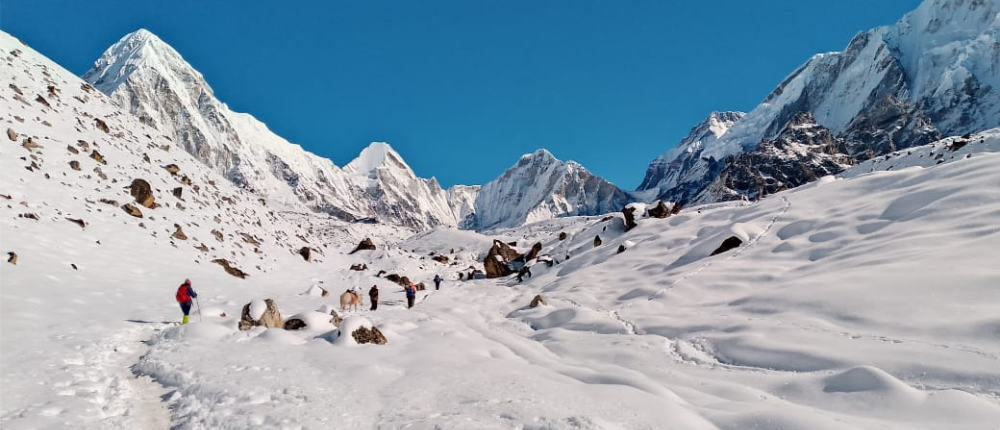
Everest Base Camp Winter Trek – trekking scenery

Next up

Day-by-day itinerary and pacing

Scroll into the detailed itinerary to review daily movement, overnight stops, elevation, and practical route flow.

Explore itinerary

Everest Base Camp Winter Trek – Day-by-Day Itinerary

Click any day to expand full details, elevation notes, meals, and overnight stops.

  1. Welcome to Nepal! 

    Your 15 days Everest Base Camp winter trek with Adventure Mountain Explore Treks and Expedition begins with you arriving at the Tribhuvan International Airport in Kathmandu- country’s first and the oldest airport.

    Upon landing and after the immigration formalities and luggage collection at the airport, one of our friendly company representatives will be there to warmly welcome you and assist  with the transfer to your pre-booked hotel.  Upon reaching the hotel, this representative will also help you to check into the hotel. Once settled, you can take some time to rest and recover from your long journey. 

    Later in the day, another company representative will meet you at the hotel lobby for a quick and short trip briefing. In this meeting, we will go over the trek details, settle remaining payments (if any), check your equipment and formally introduce you to your trekking guide, who will guide and assist you on this base camp trek. 

    However,  if your flight is scheduled to arrive late in the afternoon, evening or even at night  and if there are any delays, the briefing and introduction meeting will be conducted the next day, after the heritage tour. You can spend the rest of the day relaxing or exploring your hotel area at your own pace. 

    Overnight in a 3-star standard hotel in Kathmandu.

    Meals: None

  2. After a comfortable night in Kathmandu and a buffet-style breakfast at your hotel get ready for a full day of cultural exploration. 

    This morning, around 9:30-10:00am you will set out on a guided sightseeing tour in a private vehicle. The tour will be guided by a knowledgeable guide who will help you understand the history, traditions and stories behind the sites you visit. You will visit 4 UNESCO World Heritage Sites, namely, Swayambhunath, Kathmandu Durbar Square, Pashupatinath and Boudhanath. 

    Usually on this tour, the first site you will visit is Swayambhunath, which is also popularly known as the ‘Monkey Temple’, unless you prefer to start at a different site. Swayambhunath is one of  the oldest stupas in Nepal, rich in Buddhist symbolism and spiritual atmosphere. This site also offers sweeping views over the Kathmandu Valley.  

    After Swayambhunath, you will explore Kathmandu Durbar Square. This is an ancient palace complex that protects, preserves and showcases centuries-old art, architecture and history. It was also once a set of Nepalese royalty. 

    The tour continues to the next site, Boudhanath - the largest stupa in Nepal and a major center of Tibetan Buddhism. Colorful prayer flags, spinning prayer wheels, small surrounding monasteries and peaceful ambiance helps you feel peace and serenity, making it a very memorable stop. 

    You will enjoy your lunch here, before moving on to your next destination, Pashupatinath. 

    Located along the banks of the holy Bagmati River, the temple of Pashupatinath is one of the most sacred Hindu temples in Nepal. The temple is dedicated to Lord Shiva and is a significant pilgrim site for the followers of Hinduism living in and outside Nepal. This visit gives you the opportunity to witness traditional rituals and gain insight into Hindu beliefs and customs. 

    After a full day of sightseeing, you will return to your hotel around late afternoon. The remainder of the day is reserved for final trek preparations- picking up any last-minute items, checking and organizing your gear, and making sure everything is ready for the trek that follows.

    Overnight stay at a comfortable 3-star standard hotel in Kathmandu. 

    Meals: Breakfast

  3. Your day begins early in the morning as your guide comes to pick you up from the hotel. After a short drive, you will be transferred to the domestic terminal of Tribhuvan international airport to board your flight to Lukla. Lukla flights are mostly scheduled in the morning because weather conditions are usually clearer and winds are calmer, making flying safer. The airport reporting time is one hour prior to departure. A packed breakfast will be provided for you to enjoy on the way. 

    Lukla flights in winter months - December, January and February- are operated directly from Kathmandu, making the journey more straightforward. This short mountain flight is truly unforgettable, offering spectacular views of rolling hills, deep valleys, and snow-capped Himalayan peaks. The excitement builds as the plane lands at Tenzing-Hillary Airport, infamous as one of the most thrilling and challenging airports in the world. 

    Upon arrival in Lukla, you will be met by your porter, who will help organize and carry your luggage throughout this winter Everest Base Camp Trek. After a brief stop to prepare and get oriented, your trekking adventure officially begins. Today’s walk takes you to the village of Phakding, which lies at a lower elevation and north to Lukla. The trail gently descends from the airstrip town of Everest region and winds through small Sherpa villages, stone houses, mani walls carved with prayers and forested paths, before reaching Phakding. It is a gentle and enjoyable hike, mostly downhill, allowing the body to ease into the trekking rhythm. 

    After a relaxed first day on the trail, you will reach Phakding and settle in for the night, surrounded by the peaceful mountain atmosphere. 

    In Phakding, you will also have your lunch and around late afternoon, hike to a nearby monastery for the day’s acclimatization hike. You will then get back down to the lodge for dinner and overnight stay. 

    Meals: Breakfast, Lunch and Dinner 

  4. After an early breakfast at your lodge in Phakding, continuing your winter Everest Base Camp trek you will leave Phakding for Namche Bazaar, the bustling Sherpa capital of the region. It’s one of the most important days of the trek, as the elevation gain is quite significant. 

    The trail starts off gently, winding through pine forest and small villages, with a series of suspension bridges crossing that add both excitement and thrill to the day’s walk. The walk before the Hillary bridge is relatively easy and pleasant, allowing you to enjoy the surroundings at a comfortable pace. Along the way you will pass mani stones, prayer flags, and traditional lodges/teahouses that reflect the deep-rooted Buddhist culture of the region. 

    At Monjo, you will officially register to enter the Sagarmatha National Park, a UNESCO World Heritage Site. Your guide will take care of all national park entry formalities while you take a short rest enjoying the surrounding view. From here the trail continues along the river, towards the most iconic crossing of the day- the Hillary Suspension Bridge, hanging high above the river gorge and draped in colorful prayer flags.

    After crossing this bridge, the character of the trail changes noticeably. The path begins to climb steeply through the forest making the final ascent to Namche Bazaar challenging, but rewarding. A short climb after the Hillary bridge will also bring you to a viewpoint that offers the first view of Mt. Everest including other peaks. 

    Lunch today will be taken at one of the tea houses along the trail, giving you time to refuel before tackling the uphill section. By late afternoon, you will arrive in Namche, a natural amphitheater carved into the mountainside and the main trading hub of the Khumbu region. 

    In Namche, you will check into one of the local lodges, enjoy the comfort of the room and enjoy a well-earned dinner. It’s a long but incredibly scenic day, and settling into Namche allows your body to rest and begin the acclimatization process for the higher elevation ahead. Overnight in a lodge at Namche Bazaar. 

    Meals: Breakfast, Lunch and Dinner 

  5. This day, on this winter Everest Base Camp Trek itinerary, is a very crucial acclimatization day in Namche as it’s designed to help your body adjust to the increasing altitude. Rather than complete rest, the day is spent on a gentle hike following the principle of “climb high, sleep low”. 

    Thus, after breakfast, at your lodge, you will set out on a guided acclimatization walk, with two excellent options to choose from, depending on your pace and interest. Your guide will also advise the best option based on group and weather conditions. 

    Option 1: Hike to Everest View Hotel

    This is the most  common choice of most trekkers as this acclimatization hike in Namche takes them to Guinness Book of World Records’ highest placed hotels in the world since 2004. But it’s not the only determinant. It’s a short walk that involves steady uphill sections, making it ideal for acclimatization. The viewpoint near the hotel rewards you with breathtaking panoramic views of Mt. Everest, Lhotse, Ama Dablam, Thamserku and other Himalayan giants (weather permitting). This hike also allows you to enjoy a tea or light refreshment, while soaking in the unbelievable scenery.  

    Option 2: Hike to Khumjung and Khunde Village

    This hike is slightly longer and more cultural. This acclimatization hike takes you to two culturally rich Sherpa villages- Khumjung and Khunde. The trail ascends gently out of Namche and contours along the hillside, offering impressive mountain views along the way. In Khumjung you can explore the traditional village as well as visit the historic Khumjung Monastery, which is known for preserving what locals believe to be a Yeti scalp. Continuing on to Khunde, you can explore the village getting insight into Sherpa life, culture and high-altitude living and visit Khunde Hospital, established with support from Sir Edmund Hillary. 

    Both options allow you to return to Namche by early to mid-afternoon. The remainder of the day is free to rest, explore the lively town, visit local bakeries, browse trekking and souvenir shops or simply relax at your lodge. 

    All meals- breakfast, lunch and dinner will be provided at your lodge in Namche, ensuring a comfortable and well-paced acclimatization day. Overnight stay in a lodge at Namche. 

    Meals: Breakfast, Lunch and Dinner 

  6. After an early breakfast at your lodge in Namche, you will begin the day’s walk toward Deboche, heading deeper into the heart of the Everest region. The trail starts with a scenic and relatively gentle walk along the mountainside toward Sanasa, offering some of the most beautiful panoramic views of the trek. Along this section the stunning Ama Dablam rises prominently, dominating the skyline and the surrounding peaks, providing ample photo opportunities. The gentle trail continues to Sanasa. 

    From Sanasa, the trail descends steeply toward Phunki Tenga, located near the Dudh Koshi River. This downhill section can be hard on knees, but the rhythm of the river and shaded forest make it bearable and enjoyable. At Phunki Tenga, you will stop for lunch and take time to rest before the major ascent of the day. 

    After lunch, the trail climbs steeply through the dense forest of rhododendron and pine toward Tengboche. It’s one of the most challenging and ruthless uphill sections of the trek that demands about 2 hours of your day’s hiking time, but the peaceful forest, prayer flags and occasional glimpses of the distant peaks help break up the climb. As you approach Tengboche the landscape opens up revealing sweeping views of Everest, Ama Dablam, Nuptse and Lhotse. 

    Upon arrival in Tengboche, you will visit the famous Tengboche Monastery, the spiritual center of the Khumbu region. Here, if timing allows, you will observe the monks during their daily prayers, offering a quiet and meaningful cultural experience against the dramatic Himalayan backdrop and also take blessings from them. 

    After the monastery visit, the trail continues with a short and gentle walk downhill to Deboche, a quiet settlement nestled among forests and mountains. Here, you will check into a lodge, enjoy dinner and relax after a rewarding day on the trail. 

    Overnight stay at a lodge in Deboche. 

    Meals: Breakfast, Lunch and Dinner 

  7. After breakfast at your lodge in Deboche, you begin today’s walk towards Dingboche, a meaningful milestone on the trek as you gradually move into higher alpine terrain. This day is special because it marks your first day above the treeline and your first overnight stay above 4000 meters, where the landscape and atmosphere noticeably change. 

    Leaving Deboche, the trail gently descends and soon brings you to the last suspension bridge on the way to Everest Base Camp. On crossing it, the route opens up and the dense forests slowly begin to thin. From here, the trail follows the Imja Khola Valley, with towering peaks rising dramatically around you. 

    If you wish, there is an opportunity  to take a short detour to visit Pangboche Monastery, which is believed to be one of the oldest monasteries in the region. Despite being small in size, compared to the Tengboche Monastery, this monastery holds deep spiritual significance for the local Sherpa community and offers a quiet, reflective stop along the way.  

    Continue further to feel the transition into high-altitude terrain. Trees give way to shrubs, alpine grass and open valleys, with stone-walled fields protecting crops from cold winds. The air becomes thinner, your pace naturally slows and your guide will encourage steady walking and regular hydration- key habits as you move higher. 

    Lunch will be arranged along the trail, usually Pangboche or Somare. The final stretch is a gradual ascent through wide open landscapes, surrounded by stunning views of Ama Dablam, Lhotse, Imja Tse and the beautiful Imja Valley. 

    By mid to late afternoon, you will arrive at Dingboche, a beautiful high-altitude village set beneath dramatic mountain backdrops. After checking into your lodge, you can rest, enjoy a warm meal, and allow your body time to adapt to the elevation. 

    Dinner and overnight stay in a lodge in Dingboche, surrounded by the quiet beauty of the high Himalayas. 

    Meals: Breakfast, Lunch and Dinner 

  8. Today is another important acclimatization day, allowing your body to adapt safely to the high attitude before moving further up the valley. As with previous acclimatization stops, the day follows the principle of “climb high, sleep low”. After breakfast at the lodge in Dingboche, you will head out on a guided acclimatization hike. Depending on your energy level, weather and group condition, your guide will offer two well-established options. 

    Option 1: Half-day hike to Nangkartshang Viewpoint

    This is the most common and highly effective acclimatization hike. After breakfast, you will go up the hill located just above Dingboche, often referred to as the Nangkartshang Viewpoint. The trail is steep but short, making it ideal for altitude adaptation. From the top, you can enjoy a stunning panorama of Ama Dablam, Makalu, Lhotse, Island Peak and the surrounding Imja Valley. The effort is well rewarded and the guide will ensure a slow but steady pace with ample rest stops. After spending some time at the viewpoint, you will descend back to Dingboche in time for lunch at your lodge. The afternoon is free to rest, hydrate and enjoy the peaceful mountain surroundings. 

    Option 2: Full-day acclimatization Hike to Chhukung Valley

    For those feeling strong and wanting a longer day on the trail, this option takes you on a full-day hike to Chhukung, a small seasonal settlement at the head of the Imja Valley. After breakfast, you will leave Dingboche and walk along a wide, open trail with spectacular views of Ama Dablam, Island Peak, Lhotse and the glaciers that flow down from the surrounding peaks. Unlike the first option, this hike gradually gains elevation and provides excellent acclimatization benefits due to the sustained time spent above 4,700 meters. A packed lunch will be carried and enjoyed along the way, surrounded by dramatic high-altitude scenery. After lunch you will retrace your steps to Dingboche, arriving by late afternoon.

    Both options are designed to support proper acclimatization while offering unforgettable mountain views. In the evening, you will enjoy a warm meal at the lodge and rest well, preparing your body for higher elevations the following days. Overnight stay at a lodge in Dingboche. 

    Meals: Breakfast, Lunch and Dinner 

  9. After breakfast at your lodge in Dingboche, you begin today’s trek towards Lobuche, moving deeper into the high alpine zone of the Everest region. The landscape here is stark and dramatic, with wide valleys, glacial terrain and towering peaks all around. The air is thinner, so your guide will keep the pace slow and steady, encouraging regular breaks and proper hydration. 

    Leaving Dingboche, the trail heads north and follows a broad, open path toward Thukla (Dughla). This section of the walk is relatively easy and gradual, allowing you to settle into a comfortable rhythm while enjoying views of peaks such as Cholatse and Tawache and Ama Dablam fading into the distance. The trail crosses dry terrain with alpine grasses and yak pastures, a clear reminder that you are now well above the tree line. 

    At Thukla, you will stop for a short tea break and rest before tackling the most demanding section of the day. From here, the trail climbs steeply up to the Thukla Pass. This short but challenging ascent is slow and steady, often requiring frequent pauses. At the top of the pass, you will find a series of stone memorials dedicated to climbers who lost their lives on Everest and nearby peaks. This is a quiet and emotional place, offering a moment of reflection against the powerful backdrop of the Himalayas. 

    After the pass, the trail becomes comparatively easier, following a gradual path along the lateral moraine of the Khumbu Glacier. Although the terrain can be rocky and uneven, there are no major climbs and the vast glacial landscape creates a sense of isolation unique to this part of the trek. Snow-capped peaks surround you, and the environment feels raw and remote. 

    You will arrive at Lobuche by late afternoon. Lobuche is a small high-altitude settlement consisting mainly of trekking lodges. Here, you will check into the lodge, rest and enjoy a warm meal, and recover from the day’s walk. 

    Your guide will also keep a close watch on how you are feeling, as altitude effects can become more noticeable at this elevation. Staying warm, hydrated and well-rested is key here. Dinner and overnight in a lodge in Lobuche. 

    Meals: Breakfast, Lunch and Dinner

  10. The most anticipated day of the trek- the day that takes you to Everest Base Camp- is today and begins after early breakfast at your Lodge in Lobuche. It’s a long day of walking at high altitude, thus your guide will ensure a slow, steady pace with regular breaks. 

    Leaving Lobuche, the trail gradually ascends along the moraine of the Khumbu Glacier. The terrain is rocky and uneven, with loose stone and glacial debris underfoot, requiring careful footing. As you walk, the landscape feels stark and otherworldly, surrounded by towering and massive Himalayan peaks such as Pumori, Nuptse and Lingtren. 

    After a few hours, you reach Gorakshep, the last settlement on the Everest Base Camp route. Here, you will check into a lodge and leave your main luggage. Carrying only a light daypack with essentials such as water snacks, a jacket and your camera. 

    After a short rest, you will continue toward Everest Base Camp. The trail from Gorakshep follows the shifting edge of the Khumbu Glacier and is often the most challenging section due to its rugged, up-and-down glacial terrain. Although there is little overall elevation gain, the constant movement over rocks and ice make the walk physically demanding. 

    By early to mid-afternoon, you arrive at Everest Base Camp- a truly iconic destination. Depending on the season, you may see expedition tents spread across the glacier, with the towering Khumbu Icefall rising dramatically nearby. While Mount Everest itself is not visible from base camp, standing here among the world’s highest peaks is a powerful and unforgettable experience. 

    After spending time at Base Camp taking photos and soaking in the achievements, you will retrace your steps to Gorakshep. The return walk follows the same rugged glacial path, often feeling more tiring due to altitude and long day. 

    Upon reaching Gorakshep, you can finally rest, enjoy a warm meal and reflect on a remarkable  day in the high Himalayas. 

    Dinner and overnight stay at a lodge in Gorakshep. 

    Meals: Breakfast, Lunch and Dinner 

  11. This day begins very early, well before sunrise, as you prepare for the optional but highly rewarding hike to Kala Patthar. Wrapped in warm layers and carrying a headlamp, you set out in the cold morning air. The climb is short but steep and can feel challenging due to the altitude, yet the effort is more than worth it. 

    Reaching the top of Kala Patthar (5,550m) at sunrise is often the highlight of the entire Everest Base Camp Trek. From here, you are treated to one of the best panoramic views in the Everest region- Mount Everest standing directly in front of you, along with Nuptse, Pumori, Lingtren and the vast Khumbu Glacier. The changing colors of the peaks as the sun rises create a truly magnificent moment that will be etched in your memory for a lifetime.

    After spending time at the viewpoint of Kala Pattthar, you will descend back to Gorakshep for breakfast at the lodge. Once refueled and rested, you will begin the trek downhill leaving the harsh glacial terrain behind. 

    The trail retraces your route past Lobuche and Thukla, gradually descending into wider valleys, where landscape gradually softens and breathing becomes easier. Depending on your as well as your group member’s energy level, you will continue down to Pheriche or Pangboche, both of which sit at significantly lower elevations and offer a more comfortable night’s rest.

    As you descend, the return of alpine grassland and distant views of Ama Dablam signal your gradual re-entry into the lower elevations. By afternoon, you will arrive at your lodge, where you can relax, enjoy dinner and recover after an intense yet a very rewarding day. 

    Overnight stay at a lodge in Pheriche or Pangboche, depending on the day's plan. 

    Meals: Breakfast, Lunch and Dinner

  12. Breakfast at your lodge and you begin the long descent back to the Namche town. Today’s walk covers familiar ground, yet feels very different as the increased oxygen and lower altitude make the hike noticeably easier and more comfortable. 

    Leaving Pheriche, the trail gently descends through open alpine valleys towards Namche with expansive views of Ama Dablam, Cholatse and Tawache behind you. Continuing past Pangboche, where the landscape gradually transitions from barren high-altitude terrain back to alpine meadows and shrubs. As you lose altitude, the air warms and your pace automatically quickens. 

    Crossing the first suspension bridge on the way back, you will gradually enter the woods. Walking past your previously used night stop, Deboche, and the spiritual heart of the region Tengboche, you will steeply hike down through the forest of rhododendron and pine to Phunki Tenga, where you will have your lunch. This makes a perfect place to rest and refuel before the final climb of the day. After lunch, the trail ascends steeply through the dense forest of rhododendron and pine towards Sanasa. From Sanasa, the trail levels out and follows a scenic contour path back into Namche, offering beautiful valley views and a sense of accomplishment as you return to the lively Sherpa town. By mid to late afternoon, you will arrive in Namche and check into the lodge. 

    The rest of the evening is free to enjoy a hot shower, explore bakeries and shops or simply relax after completing the high-altitude section of the trek. Dinner and overnight ina lodge in Namche. 

    Meals: Breakfast, Lunch and Dinner 

  13. Breakfast at your lodge in Namche and you will set out on the final day of your Everest Base Camp Trek, retracing the steps back to Lukla from Namche. While the journey is mostly downhill, it is still a long and active day, so steady pace and careful footing are important. 

    Leaving Namche, the trail descends steeply toward the Dudh Koshi River, offering one last chance to enjoy sweeping mountain views before entering the forested sections below. After crossing the Hillary Bridge, you will continue along the familiar path through the forest of pine and rhododendron forests, passing small villages, mani stones and prayer wheels. You’ve seen them before. 

    The route gently undulates as you walk through Monjo and Phakding with lunch taken along the way at one of the teahouses beside the trail. The easier terrain and lower altitude make the walk more comfortable, allowing time to reflect on the incredible journey you’ve completed. 

    By afternoon, you will arrive in Lukla, where the trek officially comes to an end. No more walking. After checking into your lodge, there is time to relax, enjoy a hot shower, maybe? Or celebrate the success of the  completion of the trek. 

    In the evening, you will say a heartfelt farewell to your porters, who have played a vital role throughout the journey. This is often an emotional moment, filled with gratitude, smiles and shared memories. 

    Dinner and overnight stay in a lodge in Lukal, marking the completion of an unforgettable Himalayan adventure. 

    Meals: Breakfast, Lunch and Dinner 

  14. After an early breakfast at your lodge in Lukla, you will walk to the airport to board your scenic flight back to Kathmandu. The short mountain flight offers one last look at the Himalayas-rolling hills giving way to snow-capped peaks-bringing your trekking adventure to a memorable close. 

    Upon arrival at the Tribhuvan International Airport, your guide will help you transfer to your hotel in Kathmandu. After checking in , the rest of the morning and early afternoon is yours to rest, relax, enjoy a hot shower, or maybe take a relaxing massage and recover after the days spent in the mountains. 

    Later in the day, you may also head out for some souvenir shopping, exploring the local markets for handicrafts, prayer flags, pashmina products or trekking memorabilia. You can also grab your choice lunch at one of the many restaurants around the city, enjoying the comforts of Kathmandu after your time on the trail. 

    In the evening, you are cordially invited to a farewell dinner hosted by the company. This is a wonderful opportunity to celebrate the successful completion of your trek, share stories, and reflect on the unforgettable experience of the Everest region. 

    Overnight stay at a comfortable 3-star standard hotel in Kathmandu. 

    Meals: Breakfast and Dinner 

  15. Breakfast at your hotel in Kathmandu and your winter Everest Base Camp trekking journey comes to an end. 

    In Nepal, the airport reporting time for most of the airlines is three hours prior to your scheduled departure. Accordingly, a private transfer will be arranged to take you from the hotel to Tribhuvan International Airport, ensuring a smooth and timely departure. 

    The standard hotel check-out time is  12:00 noon. If your flight is scheduled for later in the evening or at night, a late check-out can be arranged, subject to room availability and at an additional cost. Our team will be happy to assist you with this arrangement, if required. 

    With fond memories of the Himalayas and Nepal’s rich culture, we wish you a safe onward journey and hope to welcome you back again in future for your next trek in the mountains of Nepal in the near future.

    Meals: Breakfast

Itinerary PDF

Take the full plan offline with day-by-day details, trip facts, inclusions, and planning notes.

Want this paced differently? We can shorten, extend, or make it private.

Everest Base Camp Winter Trek – Dates & Pricing

Compare scheduled departures or request a private version tailored to your group.

No group dates are listed right now, but private departures can usually be arranged for the dates that suit you.

Need a different date or a private departure?

Make it your own

Private departures can usually start on the dates that work for you, with the pace, route style, and group setup adjusted around your plans.

5+ People
Best value
Request Quote
tailored pricing

Selected option

You can adjust the traveller count again in the booking form if needed.

Trip Includes & Excludes

A clearer breakdown of what is covered and what you should plan separately.

Included

Included services will be confirmed once this product setup is completed in the admin panel.

Not Included

Personal extras and excluded services can be reviewed with our team before you confirm your booking.

Before you book

Travel insurance, personal mountain gear, and international flights are usually arranged separately. If you want help reviewing gear or insurance before you book, our team is happy to guide you.

Everest Base Camp Winter Trek – Frequently Asked Questions

Practical planning questions generated from this route, itinerary, and trip setup.

The Everest Base Camp Winter Trek is generally planned as a Moderate trek in Everest Region, with route pacing, altitude gain, and overnight stops shaped around the published itinerary. If you want a lighter or more private pace, our team can usually customize the plan.

You should plan around 15 days for the full trek, including the published route flow, acclimatization needs, and arrival-to-departure logistics. If you need extra buffer days for weather or private extensions, we can map that out before booking.

This journey reaches around 5550 and is usually best enjoyed in December, January and February. Trail conditions in Nepal can change quickly with weather, so we recommend preparing for cool mornings, layered clothing, and flexible mountain timing.

The advertised rate starts from $1,495.00 and typically covers the main trip services such as guide support, accommodation, and the core logistics listed in the itinerary. Items commonly handled separately include international flights, insurance, and personal spending, unless your custom quote says otherwise.

The Everest Base Camp Winter Trek is a strong fit for travelers looking for small, flexible groups, local lodges and trek accommodation, and a guided Himalayan experience in Everest Region. If you are unsure about fitness, private departures, or the right route style, send us your preferred dates and we will guide you to the best option.

Useful Information

Extra planning notes, route expectations, and pre-trip guidance for this journey.

Travel insurance, personal mountain gear, and international flights are usually arranged separately. If you want help reviewing gear or insurance before you book, our team is happy to guide you.

Recent guest reviews

Recent guest reviews from similar active journeys while this product gathers its first direct reviews.

Fresh route feedback

These are recent approved reviews from comparable journeys in the same destination or trip style.

Great people who arranged my trip with in my budget

"Several months ago, a friend of mine came back from world-round-trip and said, “A.B.C trekking is what you cannot see in any other places but Nepal”, and excitingly showed me a lot of incredibly beautiful pictures from t..."

"Several months ago, a friend of mine came back from world-round-trip and said, “A.B.C trekking is what you cannot see in any other places but Nepal”, and excitingly showed me a lot of incredibly beautiful pictures from the mountain and the country, Nepal. The story he shared caught my heart and strongly made me want to visit this country. And now, I also strongly recommend this adventure into wild nature. This is the reason why I am here, coming back from 10days Annapurna base camp(A.B.C) to write a review for one of the best agency (Adventure Mountain Explore Treks & Expedition P. Ltd) in Kathmandu and for you. What I have found during this trip is that this trip is therapeutic, educational, and exciting. First of all, in the mountain area, there are no such things as mobile, familiar TV show, disturbing noise, and annoying friends. You are literally surrounded by nature and all you can trust is your guide and your heart. You also have much free time in the mountain, which makes you think a lot about your future. Second, trekking is educational. You may see a various people from around the world as well as local people. This, I believe, is the best way of getting to know each other, as you will see them again and again during the trail. Exchanging their personal story and back ground helps you grow your personality as well. Third, it is exciting. There is no question about it. When I saw the panorama view from A.B.C, I got so excited that I could not take my camera away (I am sure I took more than 100 pictures and video there). That was defiantly worth it. Now, I am going to share a bit about my trekking partner, my guide, Lok Bhatta. He is friendly guy. He is not only experienced guide, but he knows how he can entertain us during the whole trip. His caring and his humor take up my good memory of trip. Since Lok and I spent 11days together, it is no wonder we became a best friends. Also he persistently looks after me. When I wanted him to take pictures, he always s..."

A Fantastic Experience!

"My mother and I arrived in Kathmandu with just 2 days to prepare for a trek around Annapurna Circuit. We feel very lucky to have met Mr. Tika Regmi and through Adventure Mountain Explore treks we were able to hire a port..."

"My mother and I arrived in Kathmandu with just 2 days to prepare for a trek around Annapurna Circuit. We feel very lucky to have met Mr. Tika Regmi and through Adventure Mountain Explore treks we were able to hire a porter-guide to facilitate exactly the kind of trek we wanted, a self-directed trek with Nepali assistance. Our porter-guide Sujan was a trusted and integral part of our little trekking party. He was very knowledgeable about the route, its hotels and side trips, and he even introduced us to local people and gave us interactions with local Nepalese that we could not have experienced on our own, like a tea in the home of a local family! We couldn’t be any more pleased with our trek. Shanna Simmons 1152 Crescent Avenue Klamath Falls, OR 97601 USA shannasimmons@hotmail.com"

Eine Erfahrung, die wir nie vergessen werden!

"Urspruenglich hatten meine Freundin und ich geplant, das Annapurna Base Camp in Angriff zu nehmen, doch Tika Regmi, Direktor von Adventure Mountain Explore hat uns den Langtang Trek empfohlen. Es war definitive eine gute..."

"Urspruenglich hatten meine Freundin und ich geplant, das Annapurna Base Camp in Angriff zu nehmen, doch Tika Regmi, Direktor von Adventure Mountain Explore hat uns den Langtang Trek empfohlen. Es war definitive eine gute Entscheidung, in eine der weniger frequentierten Gegenden Nepals zu gehen, wo sich die Anzahl der Touristen in Grenzen haelt. Das Langtang Tal bietet sowohl eine beeindruckende Bergwelt als auch urspruengliche Doerfer und somit einen Einblick in die Lebensweise der Tamang. Der Hoehepunkt unserer 8 taegigen Tour war der Aufstieg auf den 4984 Meter hohen Tsergo Ri, der eine atemberaubende Panoramasicht auf weisse Bergriesen bietet. Auf Empfehlung der Company haben wir einen Guide und einen Traeger gebucht. Beide waren ausserst zuvorkommend und freundlich, stets hilfsbereit und ortskundig. Durch sie bekamen wir nicht nur tatkraeftige Unterstuetzung beim Tragen und Pfadfinden sondern auch Kontakt zu den Einheimischen sowie Einsicht in Kultur und Braeuche. Rico Grass & Tiziana Margelist 8050 Zuerich, Switzerlanda rchico7@hotmail.com"

Lifetime experienced with Adventure Mountain Explore Treks.

"Thanks Tika We arrived in Kathmandu on November 4, 2011 with hopes to do the Annapurna Circuit Trek to Muktinah. We had no firm guide or porters arranged as yet but were lucky to stay at the Blue Horizon Hotel in Thamel..."

"Thanks Tika We arrived in Kathmandu on November 4, 2011 with hopes to do the Annapurna Circuit Trek to Muktinah. We had no firm guide or porters arranged as yet but were lucky to stay at the Blue Horizon Hotel in Thamel where we met Tika Regmi at the Hotel Blue Horizon. Tika is the director of Adventure Mountain Explore which wa located across the street. With Tika's expert help, our trek was arranged with an extraordinary guide, Sittal "Hom" Simkhada and two equally adept porters, Santosh Uperkoti and Sanjeep. Sittal knew the trail very well having done it more than 25 times. He provided information and insights about each peak and landmark along the way. He guided us up and down with care and confidence, setting a good pace that worked for each of us, our ages being 69, 67, and 30 years old. Sittal also got us to our teahouse rooms promptly and made sure we got our meals on time. We never had to ask for service; it was always provided with a smile. We enjoyed the camaraderie or our guide and porters and spent time playing cards together and exchanging stories. Clearly Sittal loved what he was doing and was experienced with every aspect of being a guide. When our daughter became ill along the way in Manang, Sittal conferred with Tika and we took an extra day to make sure all was well before continuing. There was no pressure to move on before we felt ready. When we reached the summit at Thorang la Pass we all celebrated together. It was a group achievement as well as a personal one for each of us. We are pleased to recommend Tika Regni as trek organizer and Sittal Simkhada as guide with our highest esteem and respect. Sincerely, Bob, Linda and Laura Bekes Robert Bekes Dept. of Mathematics and C.S. Santa Clara University Phone: (408) 554-4883 Fax: (408) 554-2370 rbekes@scu.edu"

Ready for the Everest Base Camp Winter Trek?

Join 5000 travellers who have trusted Adventure Mountain Explore for thoughtful planning, dependable support, and memorable Himalayan journeys.

Secure Booking Helpful Human Support Trusted Himalayan Travel Company 5000 Trekkers